Local

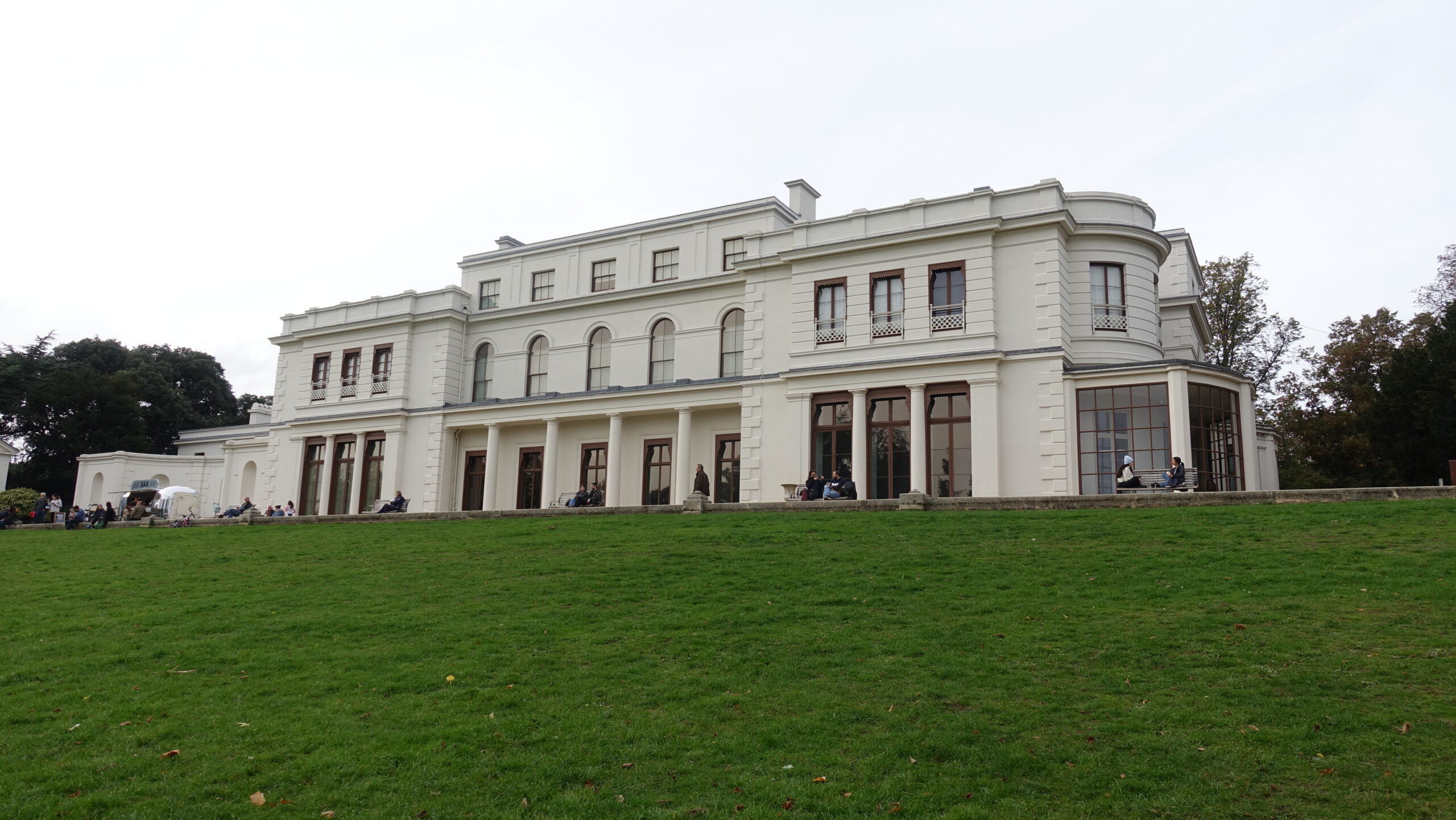
Gunnersbury House

Gunnersbury House

October 16th, 2022 was a Sunday and it dawned a gorgeous sunny day, so we decided we should do something and go out. My first idea was to go to Syon House, but Wendy persuaded me that it was too big, and the disabled car park seems too far from the house, so I thought again and decided to explore Gunnersbury House and Park which Wendy had not heard of, But I was aware that HADAS had been there to help out and I wanted to explore. It is a fine Georgian house just off the Great West Road and the North Circular, and it had been the home of the Rothschilds.
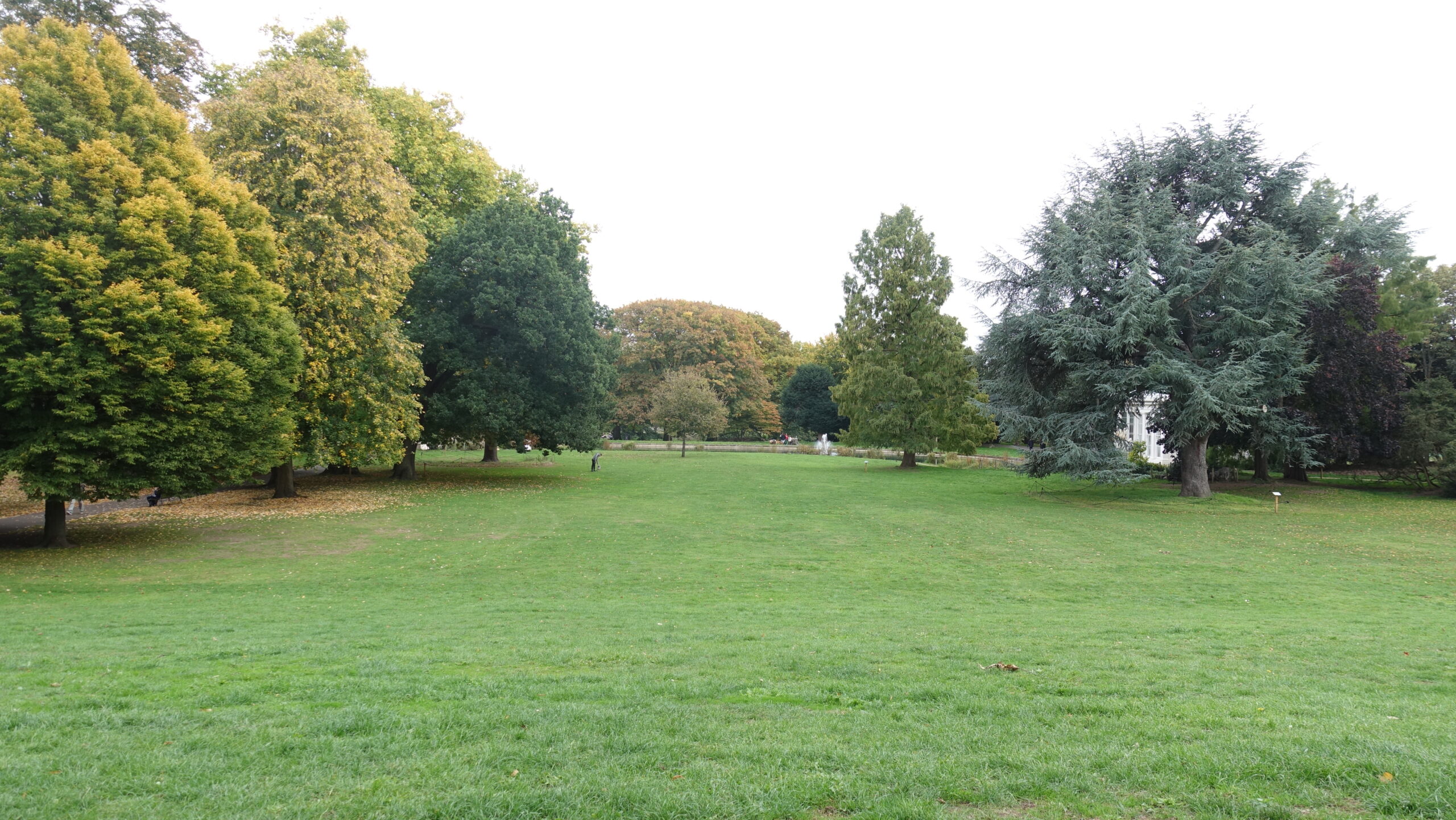
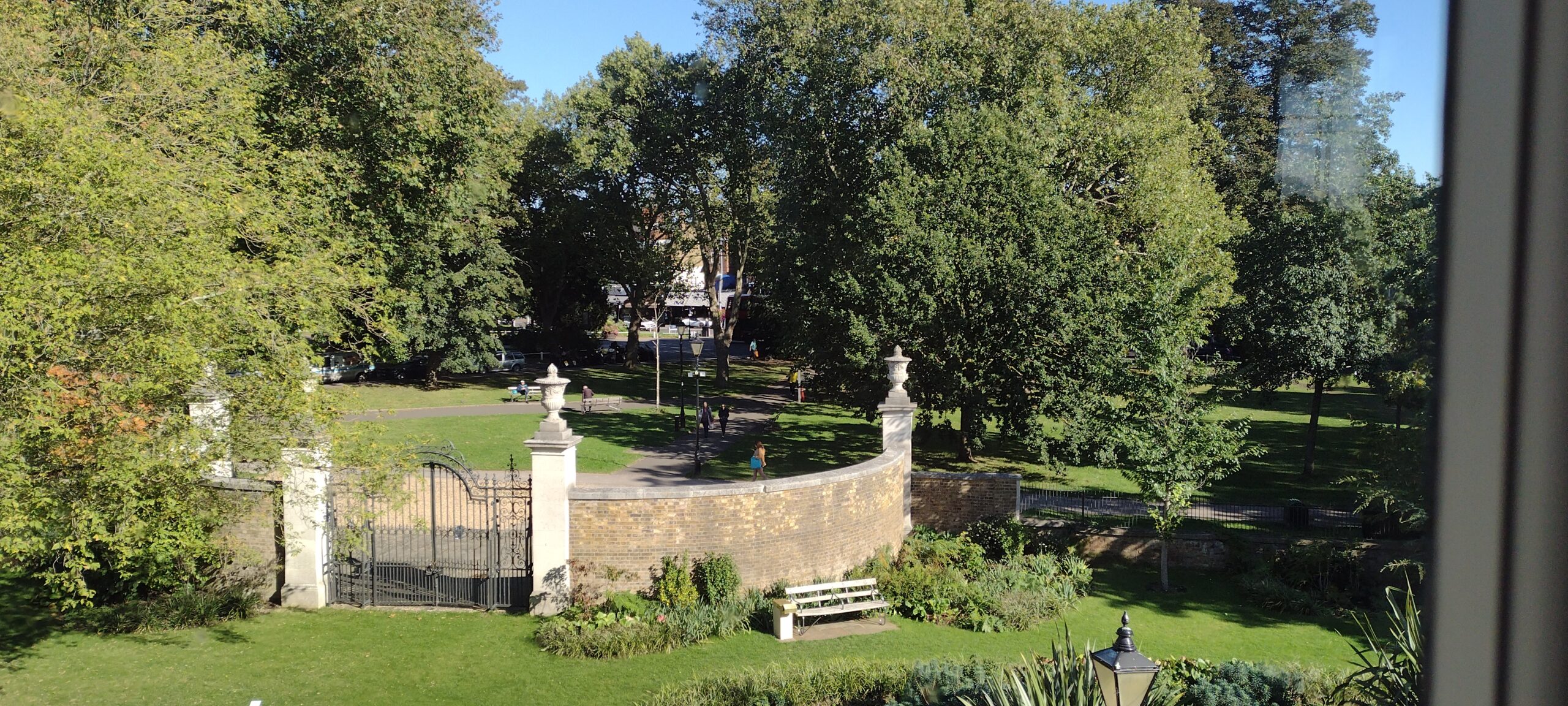
The Rothschilds were keen on botany and natural history, so they laid out a magnificent garden with exotic trees imported from different parts of the world as can be seen on the left. In the centre of the photo, a fountain can just be seen, while to the right a Grecian temple just peeps through the trees.
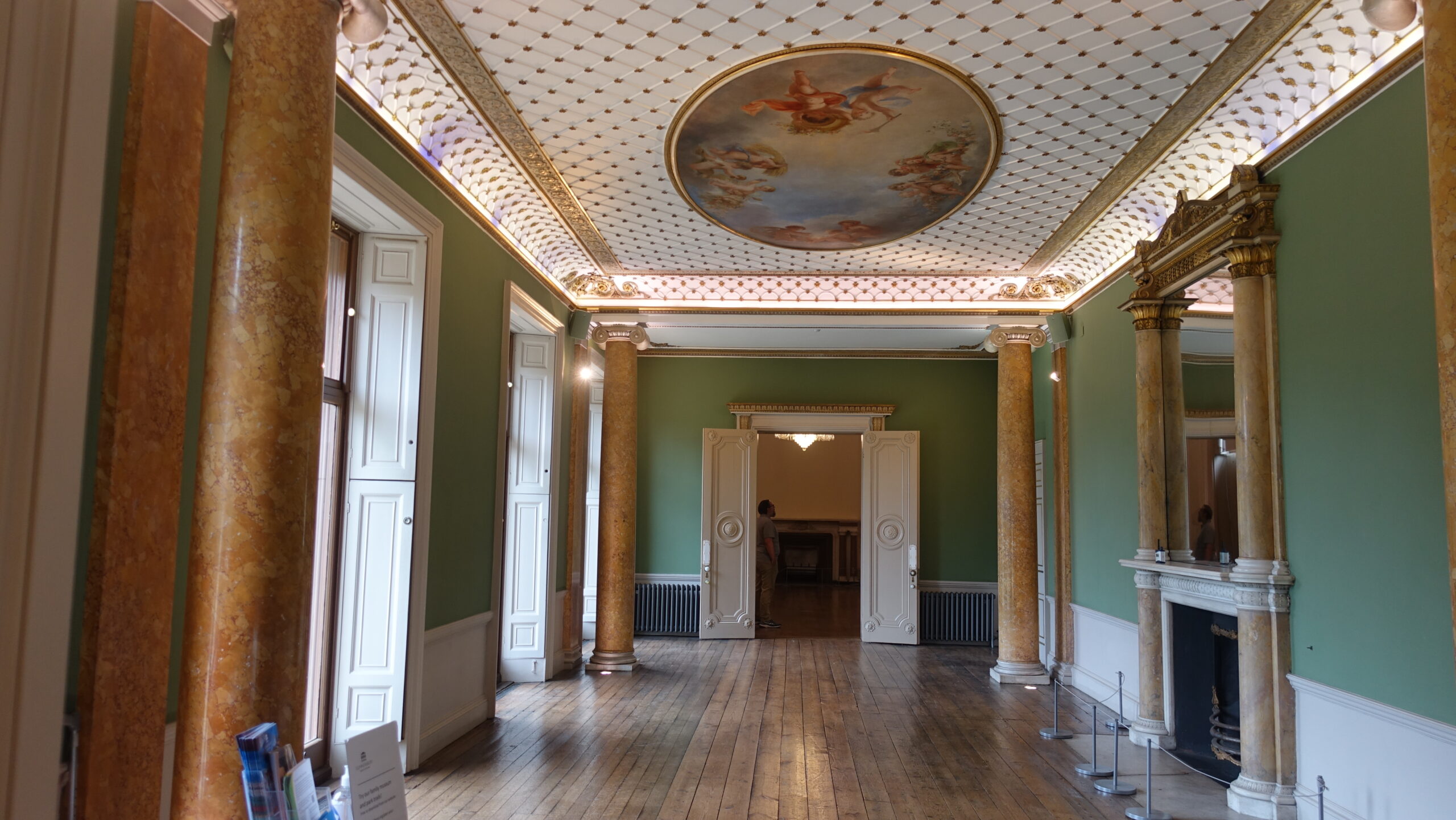
The Long Gallery

This is the finest room in the house. It faces south and over the gardens, with magnificent views and has a fine painting in the ceiling.

And although the Rothschilds were the most distinguished owners of the house, they did not build it. The original house was built in 1663 as a Palladian mansion, and it was here that Princess Amelia, the daughter of George II lived from 1761 to her death in 1786.

However, in 1801 it was pulled down by John Morley, who proposed to sell the whole estate in 13 lots for houses. However, Alexander Copland bought 12 of the lots, and built a Large Mansion, which is the house we see today. Shortly afterwards the remaining lot was bought by Alexander Morrison, who built the Small Mansion which has still not been fully restored and is under scaffolding.

However, in 1834. It was bought by Nathan Mayer Rothschild and remained in the Rothschild family for the rest of the century
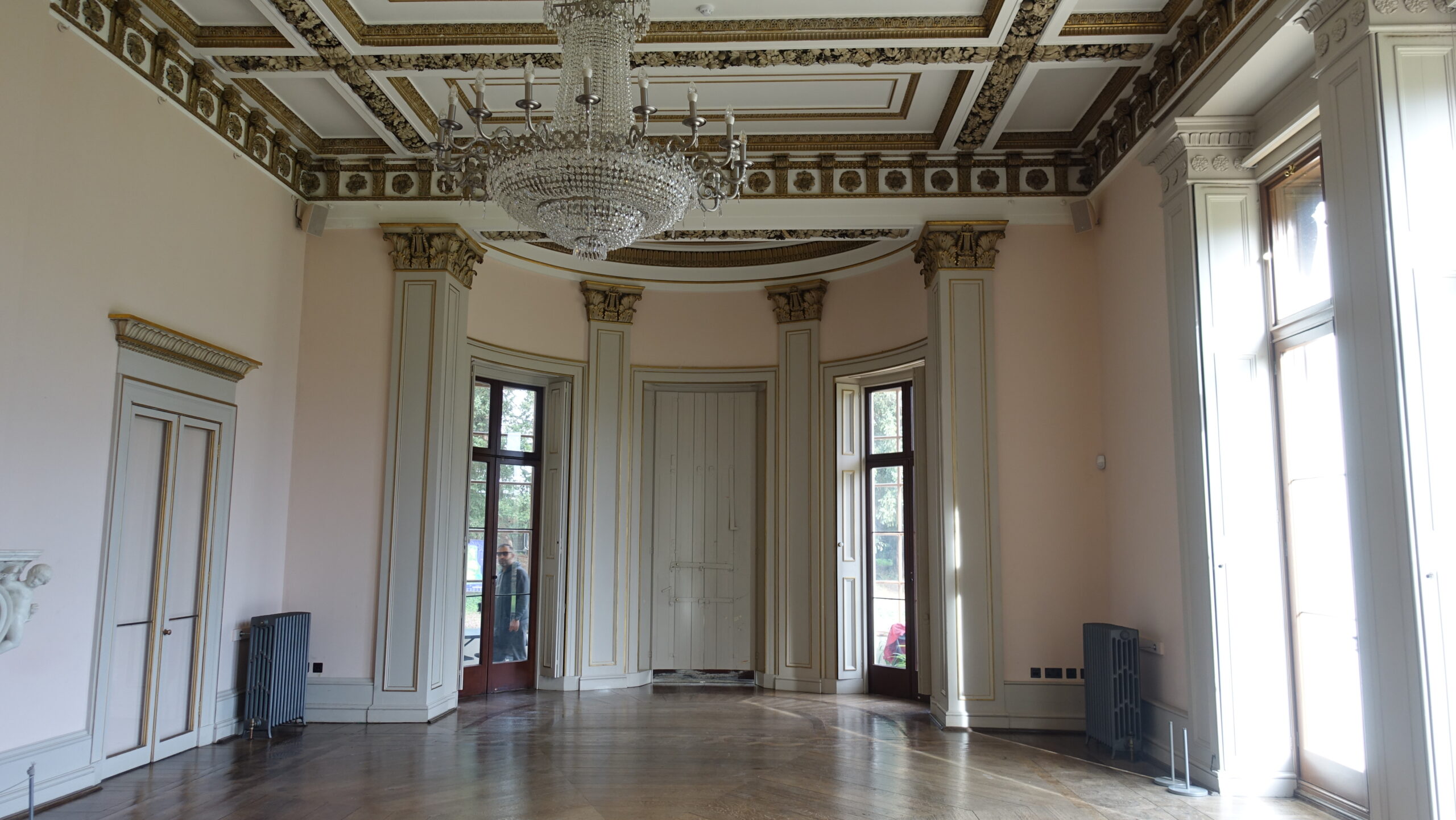
Drawing Room and Conservatory

This is the another fine room, adjacent to the Long Gallery, looking south over the garden. At the far end behind the doors is a conservatory which was built by the Rothschilds and had curved panes of glass of which they were very proud. It is a pity there is no furniture – it makes it look very bare.

The Rothschilds were a very extended family which was one of the secrets of their success. They were founded in the 1760s by Mayer Amschel Rothschild in Frankfurt who had 5 sons who settled around Europe, and the London Rothschilds became very successful. The Gunnersbury estate was bought by Nathan Mayer Rothschild in 1835, but he died soon after and the house was mainly occupied by one of the junior branches of the family, headed by Leopold, who was a nephew but who nevertheless eventually became head of the bank, though I think he was more interested in horseracing than in banking.

The kitchens

The Rothchilds were great entertainers, so the kitchens had a major role in the running of the house and have been lavishly restored, This is the main kitchen with the main range to the left and a brand-new and very early gas stove at the far end, put in in the 1860s.

The current ownership of Gunnersbury is unusual. On Leopold’s death in the 1920s, his widow decided to sell the estate, but she wanted it to be kept as a park. The estate lies within Brentford Borough Council, but Brentford had a reputation for selling land for housing, so it was sold to Ealing Borough Council, which is adjacent. Ealing was joined by Acton which has now become part of Hounslow, who hold it jointly. It was opened with great ceremony by Neville Chamberlain, the Minister for Housing in 1926.
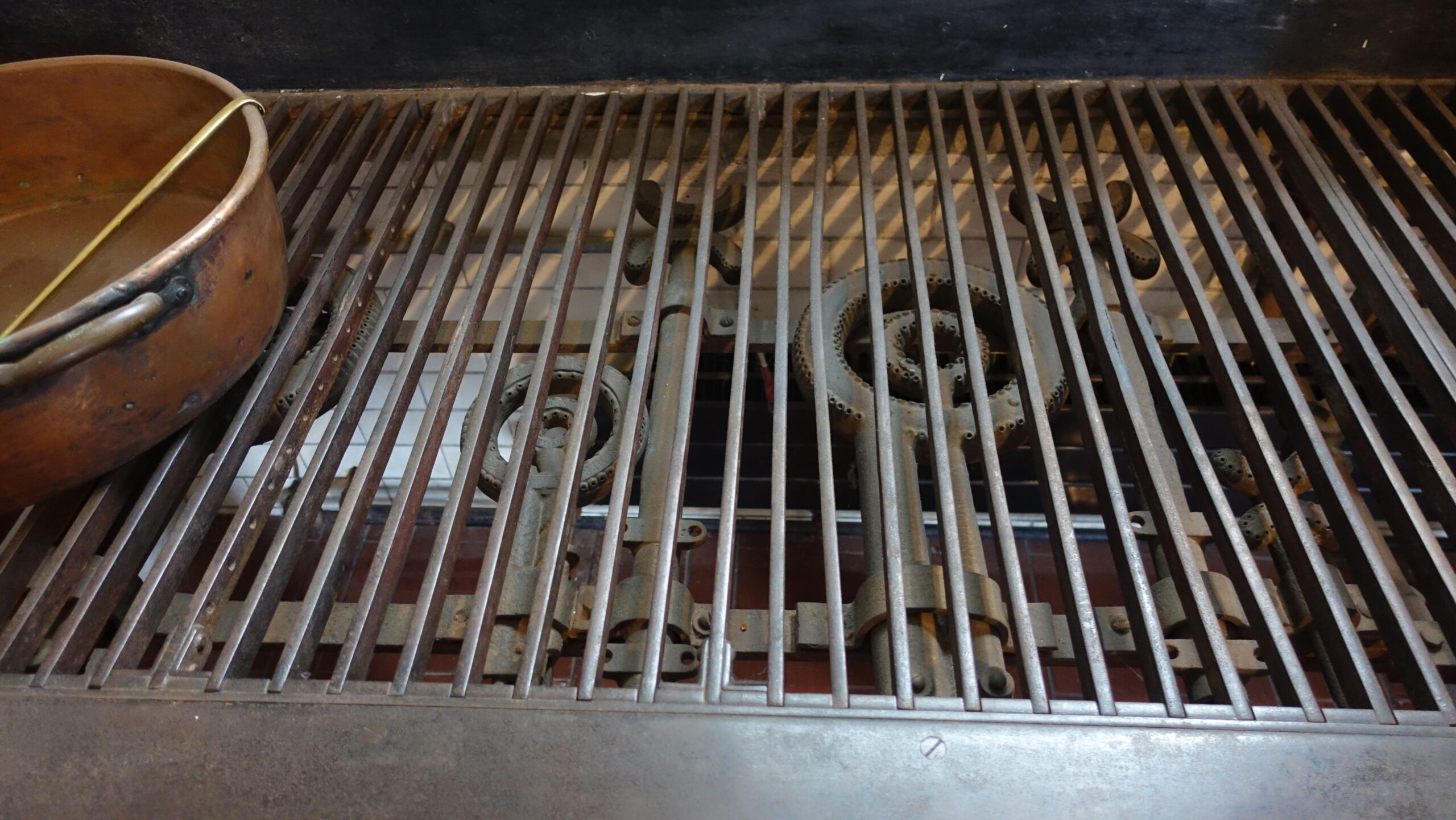
The gas stove

In the 1860s a gas stove was installed – the height of modernity. The great advantage was that when the great stew pots as seen on the left had finished their cooking, they could be left on the stove, whereas before they had to be removed from the flames – and they were very heavy.

In the late 20th century, the Gunnersbury estate became rundown as it was a drain on the Boroughs’ finances, so they applied to the Lottery fund and received a grant of £50 million, as a result of which the Large Mansion has been restored and looks very spick and span though sadly it lacks furniture. The grounds have also been restored, though work is still in progress.

When we finished our visit, there was one thing we found very useful – a disabled car park very close to the house. When we arrived there were notices saying no entry to cars except for those with a blue badge and as we have a blue badge we sailed through and found the disabled car park. At the end of our visit, when we were both exhausted, we were delighted to be able to drive home so easily!

The National Archive

The National Archives

Who lived at 16 Clarence Road?

A visit to the National Archives

On 1 October 2022 we visited the National Archives, on a trip organised by the Kew Society and the Richmond Local History Society. I had been there before, but only in the dark, so I had not seen the grand entrance. However on this occasion, we managed to find the disabled parking at the rear. We went to the first floor where computers were set out. We took one each and set out to explore for ourselves.

The target was the census of 1921. A census is taken every 10 years, but they are kept confidential for 100 years, so the 1921 census is the latest available, as the 1931 census was bombed during the war. Wendy and I took a computer each and set to work to find out who was living in Clarence Road in 1921

Clarence Road was built in the decade before 1891, as it does not appear in the 1881 census.

Its first occupants were a German family, the Koppelows. Mr Koppelow was a German who went travelling in Ireland where he seduced a young Irish girl and married her and took her back to Germany, where she had a son Charles, who was born in Prussia. They then came to England and settled in Kew. However Mr Koppelow died, leaving his widow Esther as the mistress of 16 Clarence Road.

There was also her son, Charles, who was still at school, and also a lodger a 20-year-old French girl, Francis Schutte, studying engineering, There was also a live-in maid, Lizzie. Hobbes

Ten years later there were two old women living here, Emma Heath, aged 63, who was living on her own means, and her housekeeper Henrietta Welch, who was just two years younger. I hope they looked after each other.

There is no entry in the 1911census the records simply go from number 15 to 17. Presumably either the inhabitants were away on that particular day or the house was being sold.

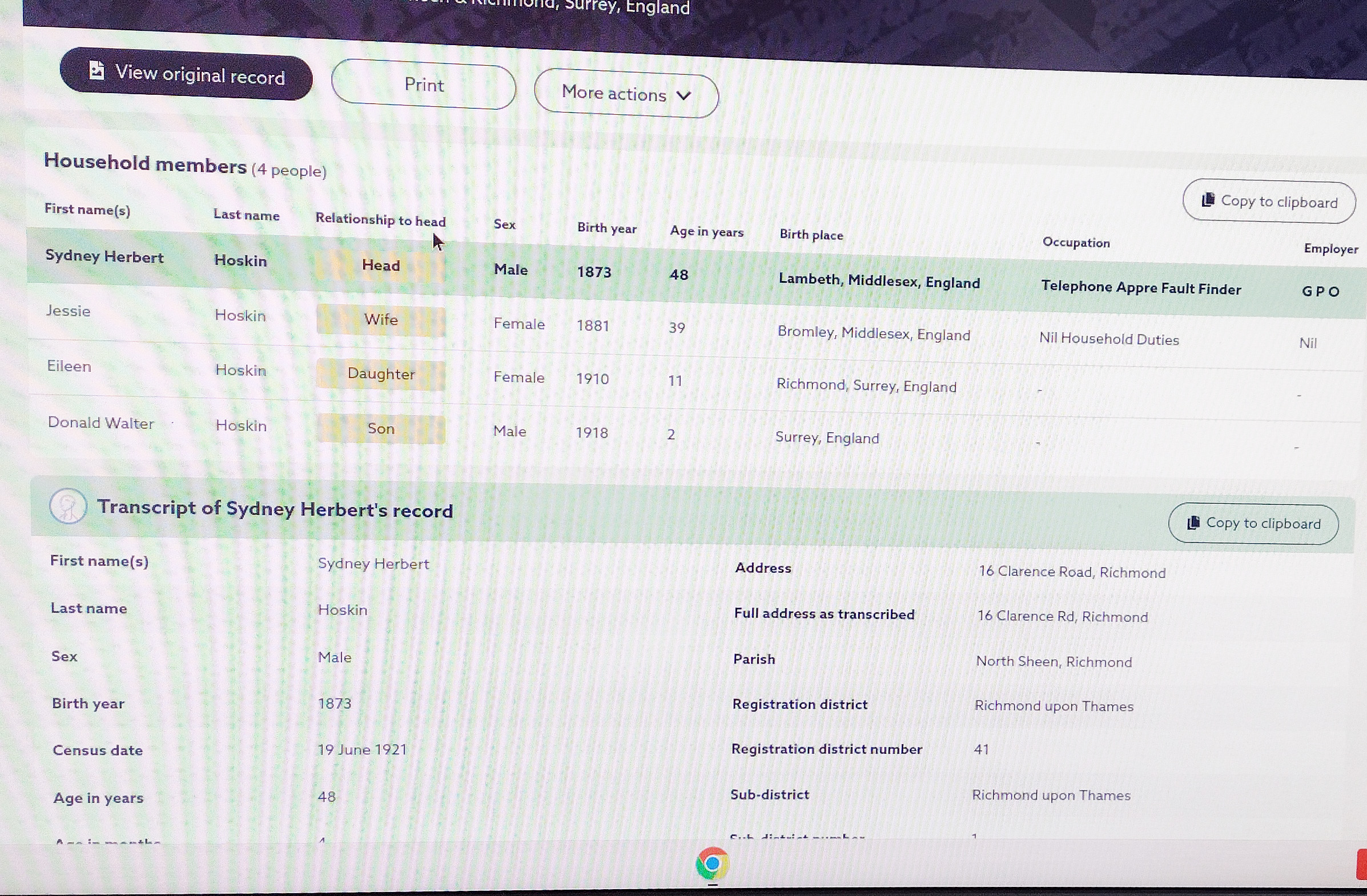
In 1921 the house was being occupiers by two families, the Hoskins and the Eltons. The father Hoskin, Sydney, was a telephone fault finder, aged 48, whose wife Jessie was nine years younger and was in household duties.

They had a daughter Eileen aged 11, was born in 1910 and is registered as having been born Richmond. Does this mean that were already living in Clarence Road and just happened to be away on the day that the census was taken? There was also a son, Donald, who was nine years younger. Was he an accident?

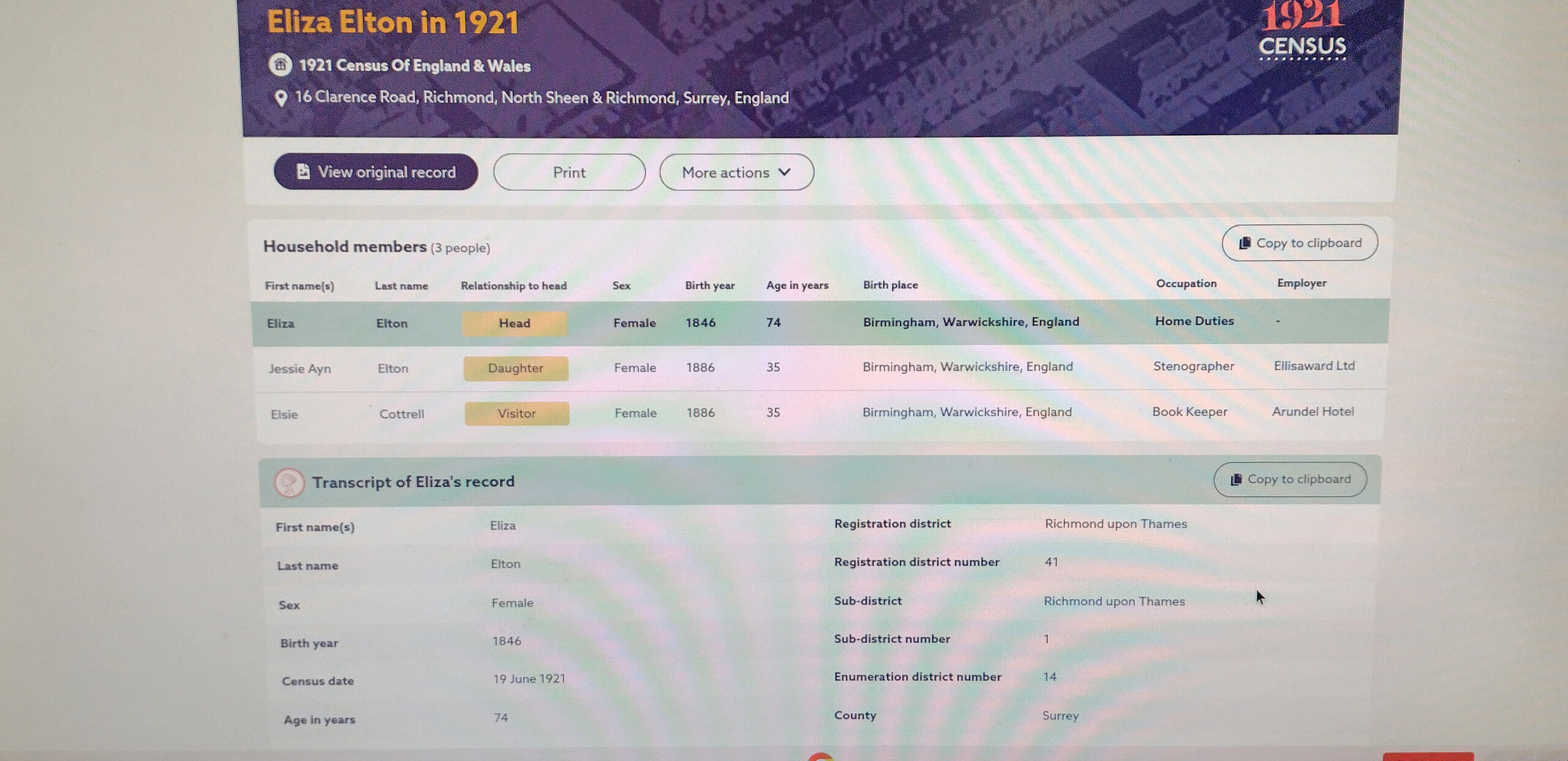
And then there was a second family, the Eltons, all from Birmingham. The head of the family was Eliza aged 74, described as being employed in household duties. Then there was her daughter, Jessie, aged 35, who was a stenographer. And then there was a ‘visitor’, Elsie Cottrell, also from Birmingham, also aged 35, who was a bookkeeper at the Arundel hotel. She is called a ‘visitor’ but was she fact a lodger, and were the two girls, both 35, both from Birmingham, both good friends?

The house must have been crowded, with two families, seven in all. One wonders whether there was an additional building either out the back, or perhaps at the bottom of the garden on the site of the garage, with a back door leading out into Victoria Gardens? Is this perhaps where the Eltons lived?

No census was taken in 1941, because of the war, but similar information can be obtained from the National Register that was compiled on 29 September 1939 for the civilian population. This was primarily to issue identity cards which remained in force until 1951, and also for Rationing cards when rationing was introduced in January 1940. It was also to help in conscription for the forces and the direction of Labour.

Only a single person is recorded as living in 16 Clarence Road, being Florence Wright, a single lady aged 44, working as a bank clerk

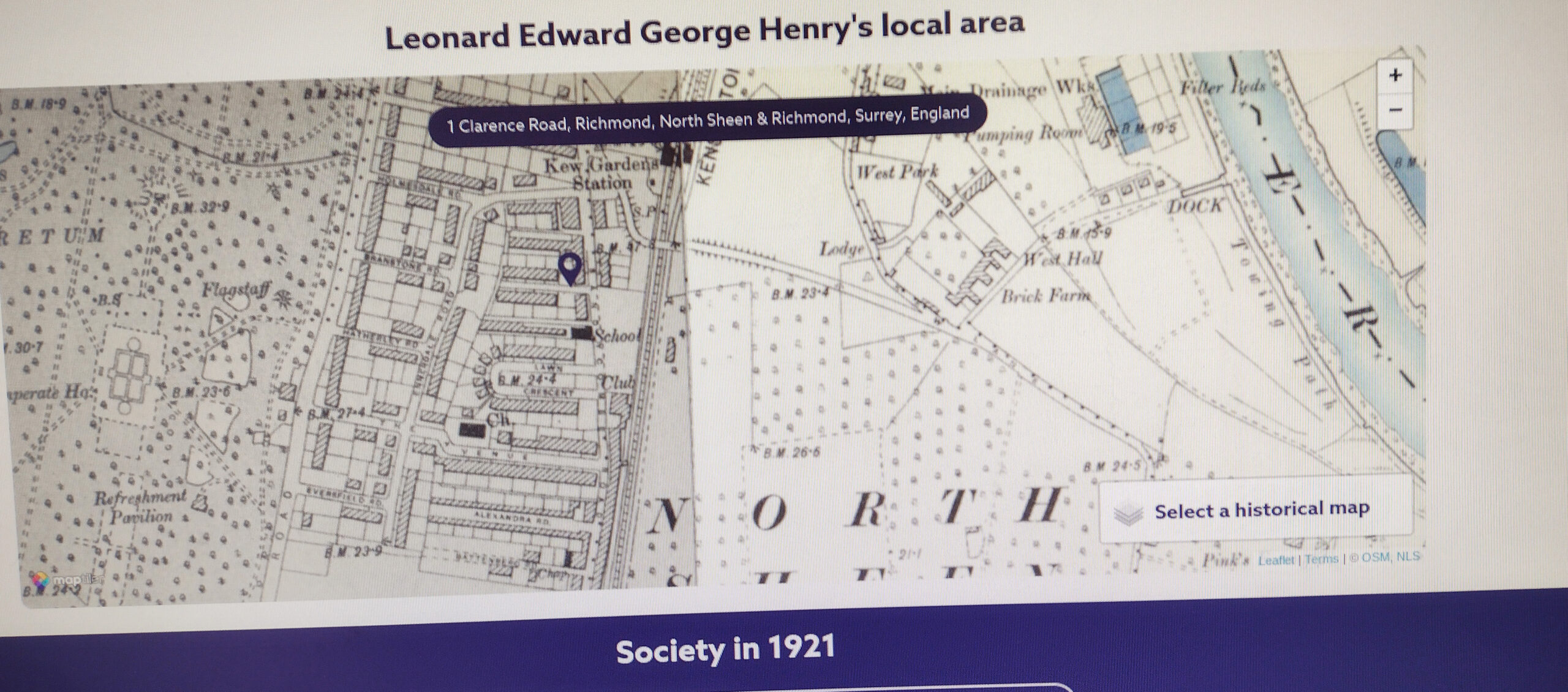
The listings were all accompanied by maps – if you scrolled down to the bottom of the entry. So here is a map of our area for 1 Clarence Road.

It is interesting to see that the area between the railway and Kew Gardens was all built up, but the area on the other side of the railway was not built up at all. Though if one looks carefully, the area between Sandycombe Road and the railway was only partially built up by 1921.

Fulham Palace

Fulham Palace

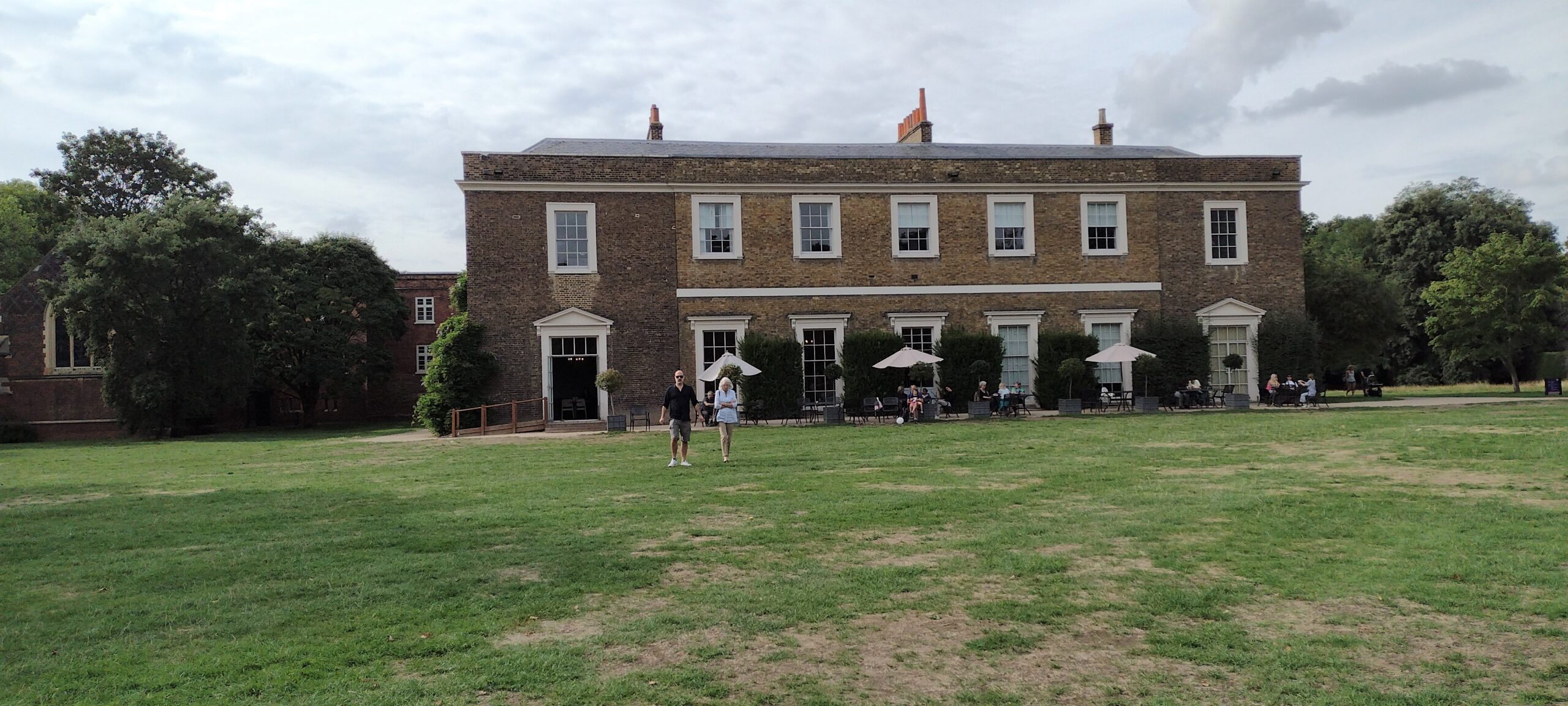
The East Wing of the Palace, cobbled together in the 18th and 19th centuries. It is rather underwhelming as the principal facade overlooking the lawn, but the ground floor now serves as the cafeteria

I have been wanting to go to Fulham Palace ever since I heard a lecture on it at the Richmond Archaeological Society. Well, another lecture is coming up, so I thought I had better delay no longer, so I could appreciate what the forthcoming lecture is all about..

I had been saying that I wouldn’t go on a weekday to avoid the crowds, and that I would go on a nice sunny day. Well, I missed all the nice sunny days in the summer of 2022,  and eventually with the next lecture coming up, I decided to go on a Saturday, 3rd September 2022. It was a dull day and we coincided with a wedding, so we couldn’t see the main Tudor Court. But we saw the Museum and the Great Hall, so we still has a good visit and Wendy enjoyed it.

Fulham Palace was the home of the Bishops of London on a riverside estate acquired by Waldhere, the Bishop of London in 704. However it was rather large, and not very central to London, so in 1972 it was given up, in favour of a small house in central London just by St Paul’s, which is, after all, the Church of the Bishop of London, and it is now run by a trust.

It is in two parts. The original half is the  Tudor Court, which was where the wedding was being held, so we couldn’t get in to see it. Then in the 18th and 19th centuries  it was considered to be too old-fashioned, so new buildings were added around what became the East Court. We saw the museum rooms and the Great Hall,  where Wendy identified the portraits of the various kings and queens, and we then went through the northern wing of the East Court till we came to the  Drawing room, which is now the cafe. There we each had a large coffee and shared a piece of chocolate cake between us  – Wendy allowed me half, despite my diabetes.

One of the walkways in the Walled Garden

We then walked across the lawn to the walled garden. In the 17th century, the Bishop of London was also the head of the church in the American colonies, and Bishop Henry Compton (1675 – 1713) was a keen botanist, so he sent out Rev Banister, himself a keen botanist as a missionary and plant collector to Virginia, who sent back  many plants including magnolia and box elder. In 1764 a walled garden was constructed, with an earlier Tudor gateway which I failed to photograph.

We got there just before it was closing. We saw part of it until we were chased out, and Wendy went on ahead to go to the shop to buy greetings cards and I returned to the car in the disabled car park. And so to home.

Jubilee party

Jubilee Party, 2022

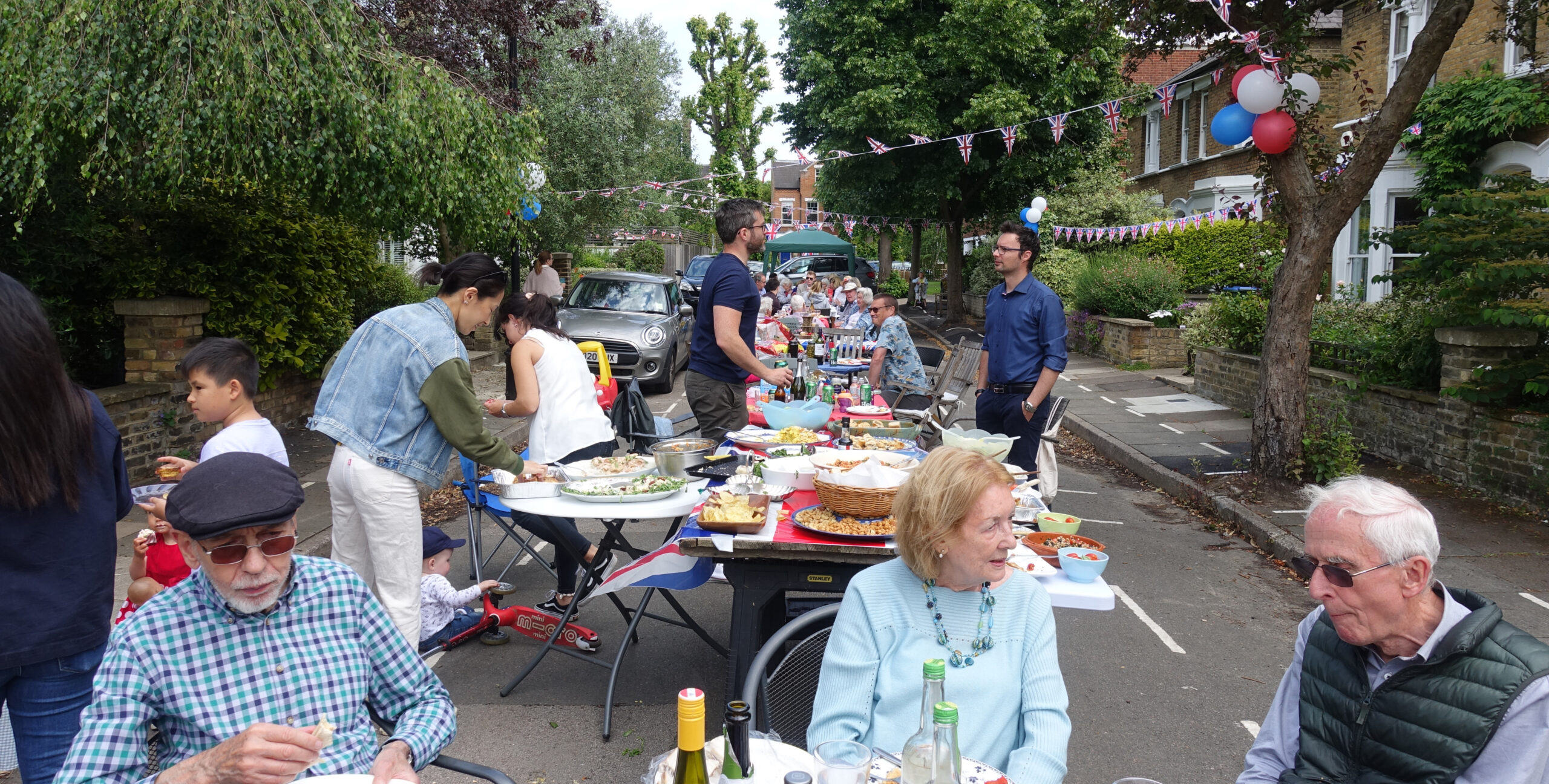
On the 4th of July 2022, we celebrated the Queen’s Platinum Jubilee – 70 years on the throne. We had a street party. Clarence Road was closed off, there were no cars, and we dined down the middle of the road.

It was a fine day. The weather threatened to be rainy and there was some rain early morning, but then the sun came out and it was a fine day for the party – and no planes either.

Bunting was laid down the street, tables were laid down the centre – we brought out the table from the garage – and everyone prepared food.


Ian, working hard to get the tables ready

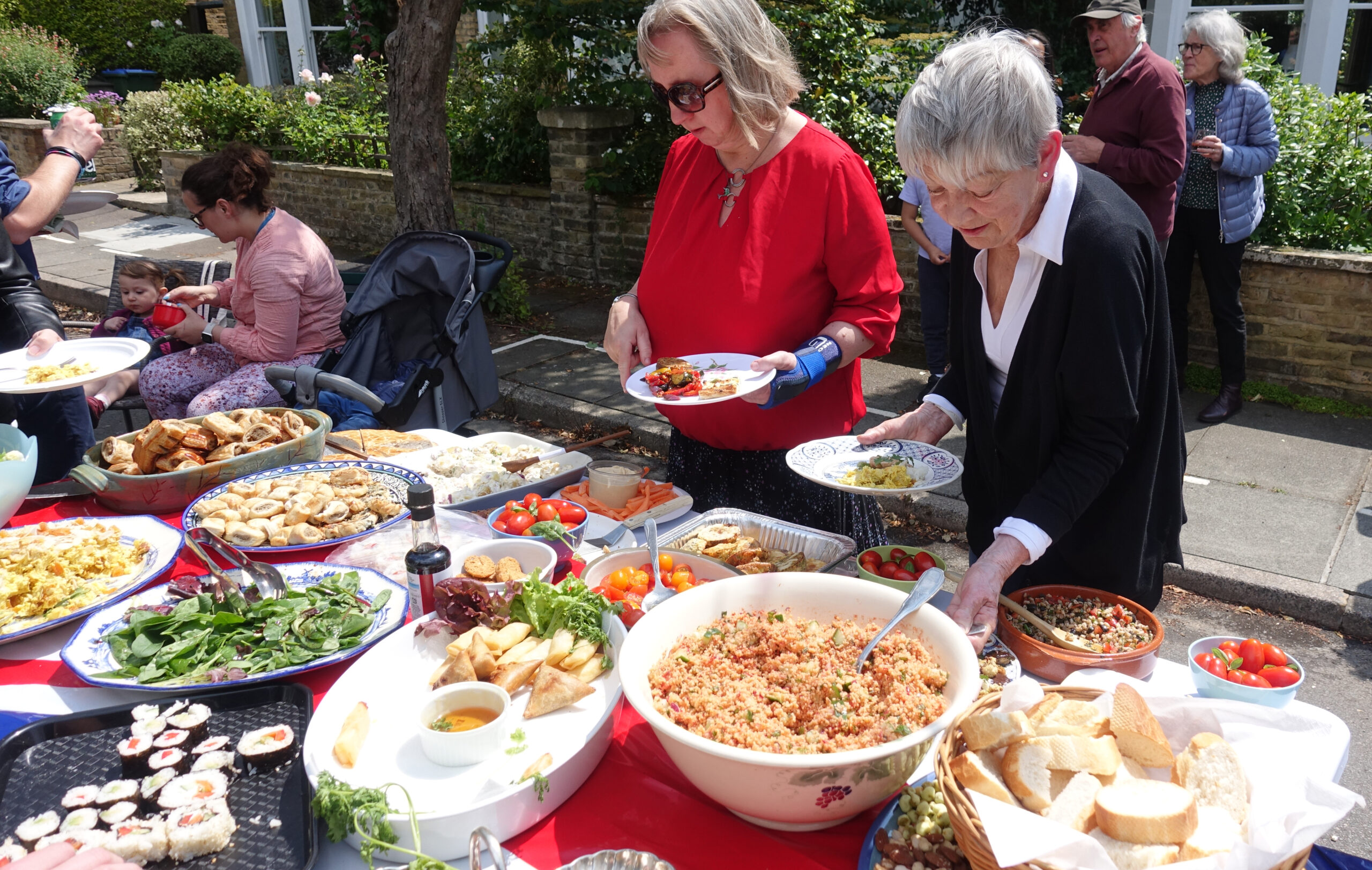
Delicious food was prepared and laid out on the central table – everyone competed to see who could bring the most tasty food

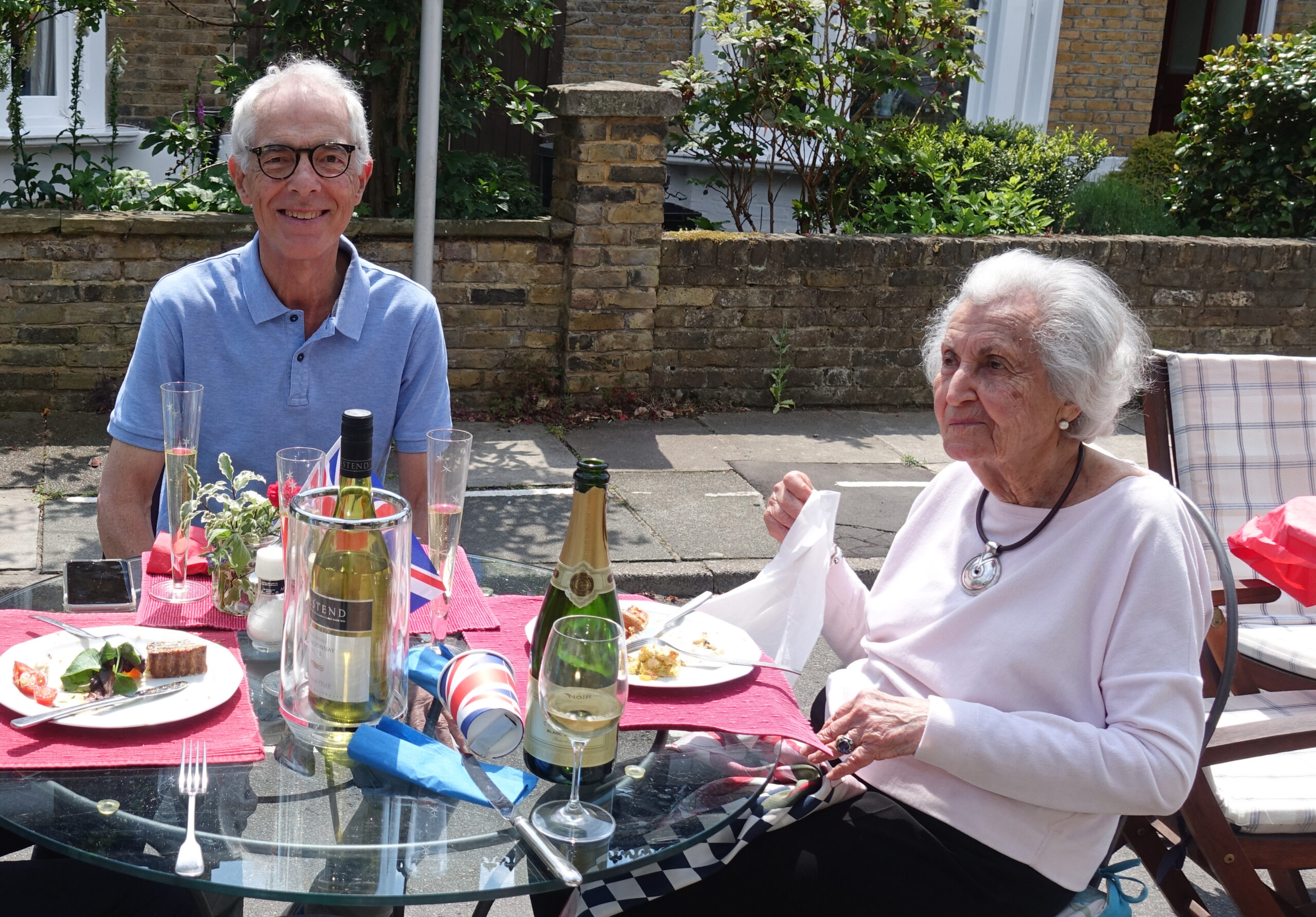
And then we feasted. Jonathan and friend dined in high style, enjoying the food

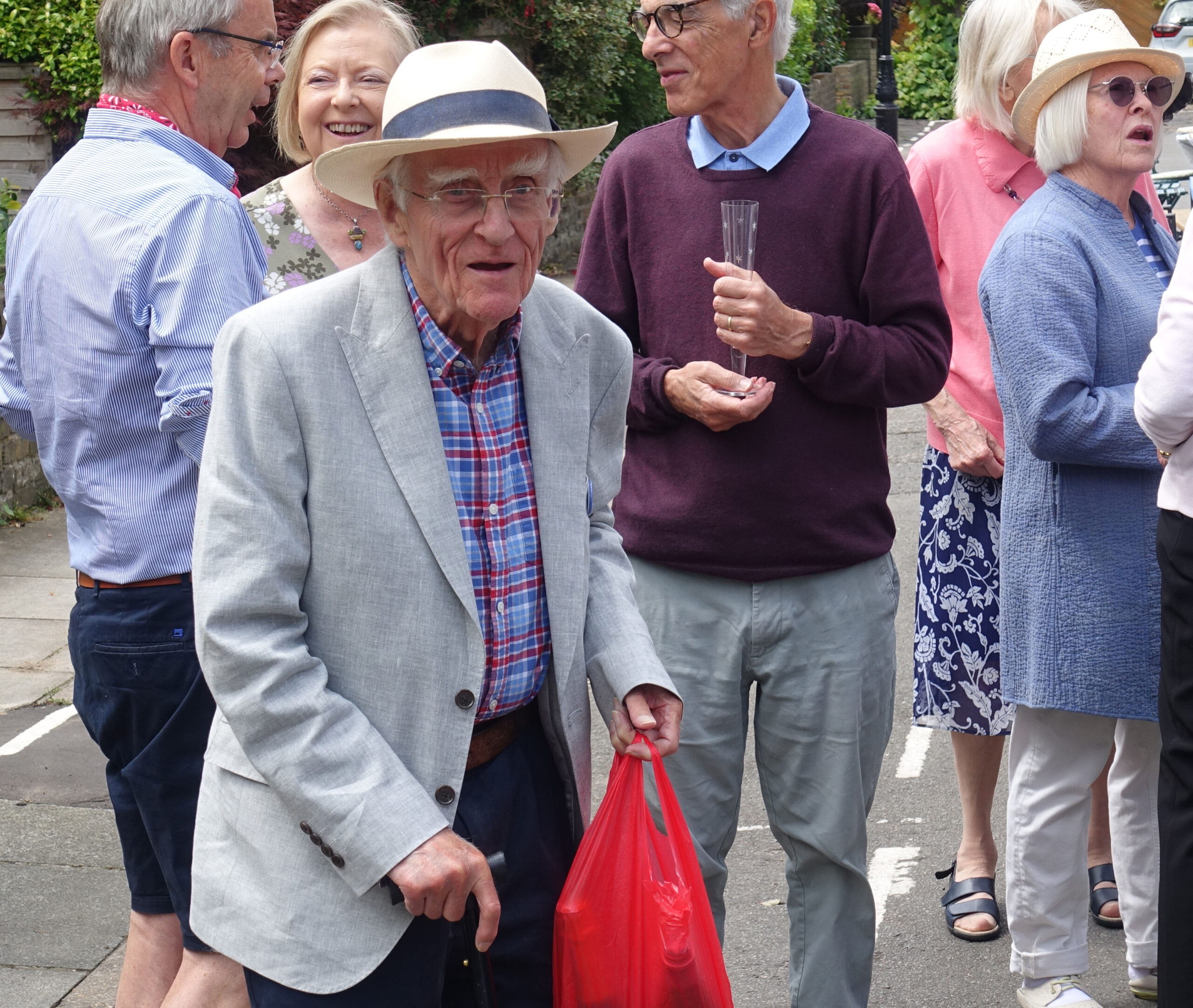
Deep conversations took place while enjoying the meal in the middle of the road

And then it was time for pudding! Here is the champion cake, in the form, of a Union Jack. It did not survive long. Adjacent to it were the strawberries – specially for me, as the only food allowed for diabetics

Photographing the cakes – a record for posterity.

.

John, in full flood of discussion

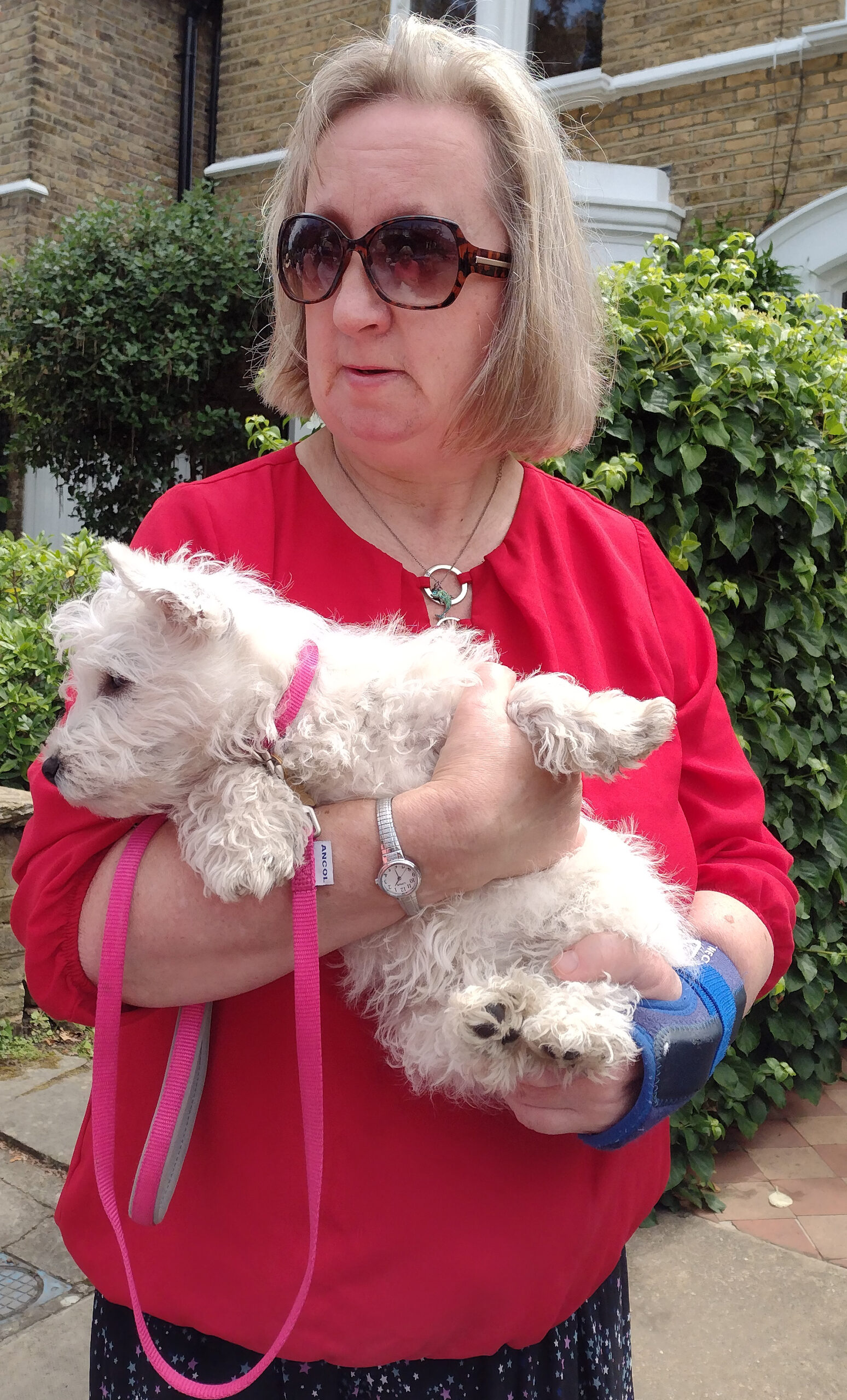
Fiona has captured a dog and is giving it her full treatment. She was very happy – and the children enjoyed the dog too.

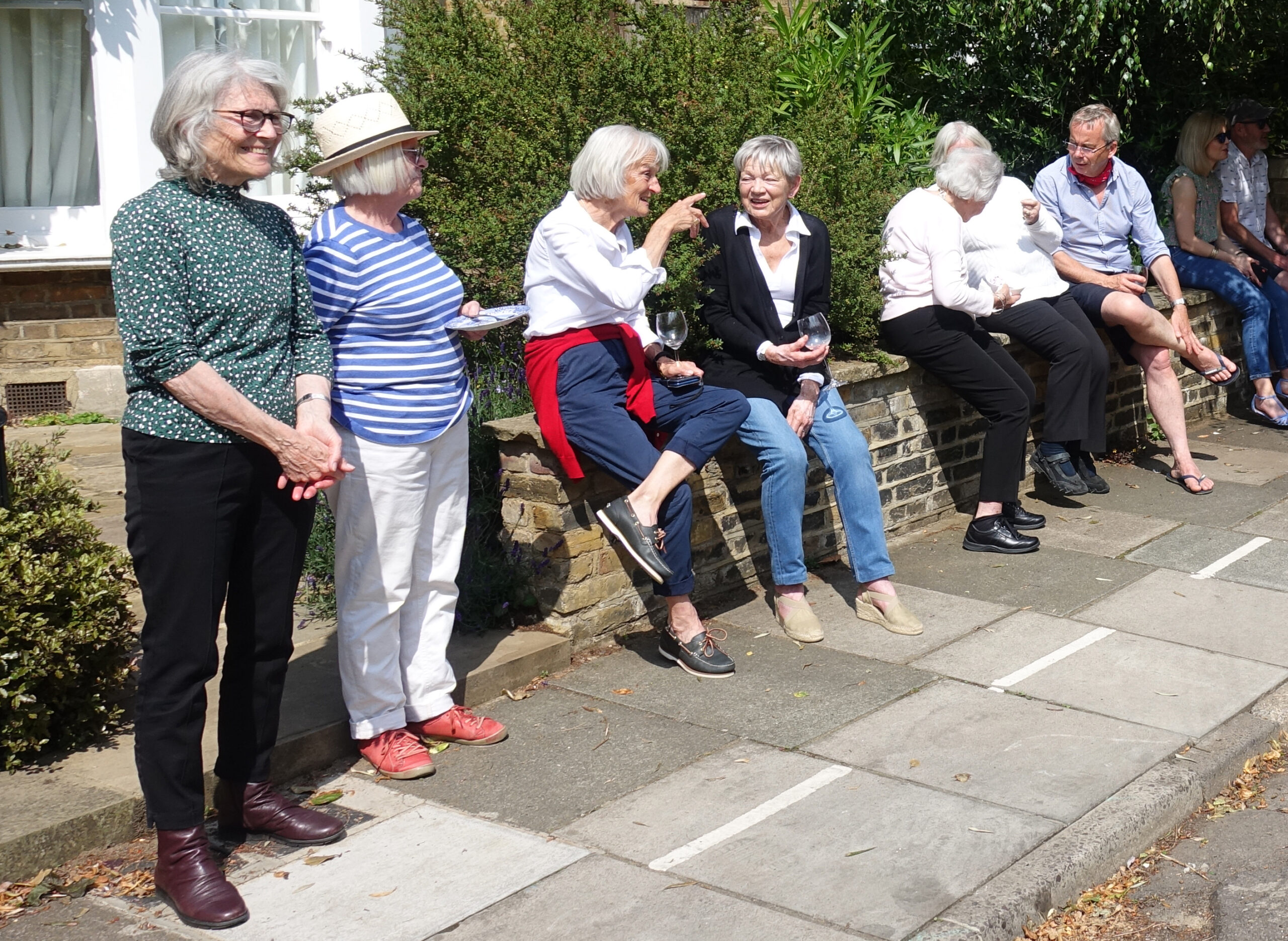
Finally, the food was eaten, and it was time to relax, sitting on the wall and just talking.

It’s been a lovely afternoon and a wonderful way of celebrating the Queen who has reigned for almost as long as many of us have lived. Only the previous day we celebrated our wedding anniversary by going out for a meal and we realised that our marriage at a mere 56 years long is nowhere near as long as the Queen has reigned.

I read recently an article asking how much the celebrations cost. Well in our case, the answer is nothing – at least as far as the state is concerned. We paid for it ourselves: we all chipped in £5 which paid for the cost of closing the road (which we had to pay for) and for the bunting, but that’s about all.  We provided the food, the tables, the coverings, and the good companionship.  

It was wonderful meeting so many people we had only nodded to before – and the Lithuanians who live opposite. It is wonderful to live in such a friendly road, so thank you very much to those of you who bore the brunt of the organising – you did a really wonderful job. And cheers to her Majesty: let’s hope she lives just a little bit longer so we can have some more wonderful jubilees!

Andrew Selkirk

5th June 2022

Ealing, 2021

Ealing, 2021

On October 6, 2021 I visited Ealing. We had just returned from our visit to my brother in Spain,  and two days after our return we had to do a Randox test for Covid. After our previous test after our visit to France, we had used a drop box in Isleworth, but this had closed and the nearest drop box was in Ealing.

In a way I quite welcomed the opportunity to do some exploring. The main thing I wanted to see was the site of Ealing Studios whose comedies I had much enjoyed, and I found they were on the route.

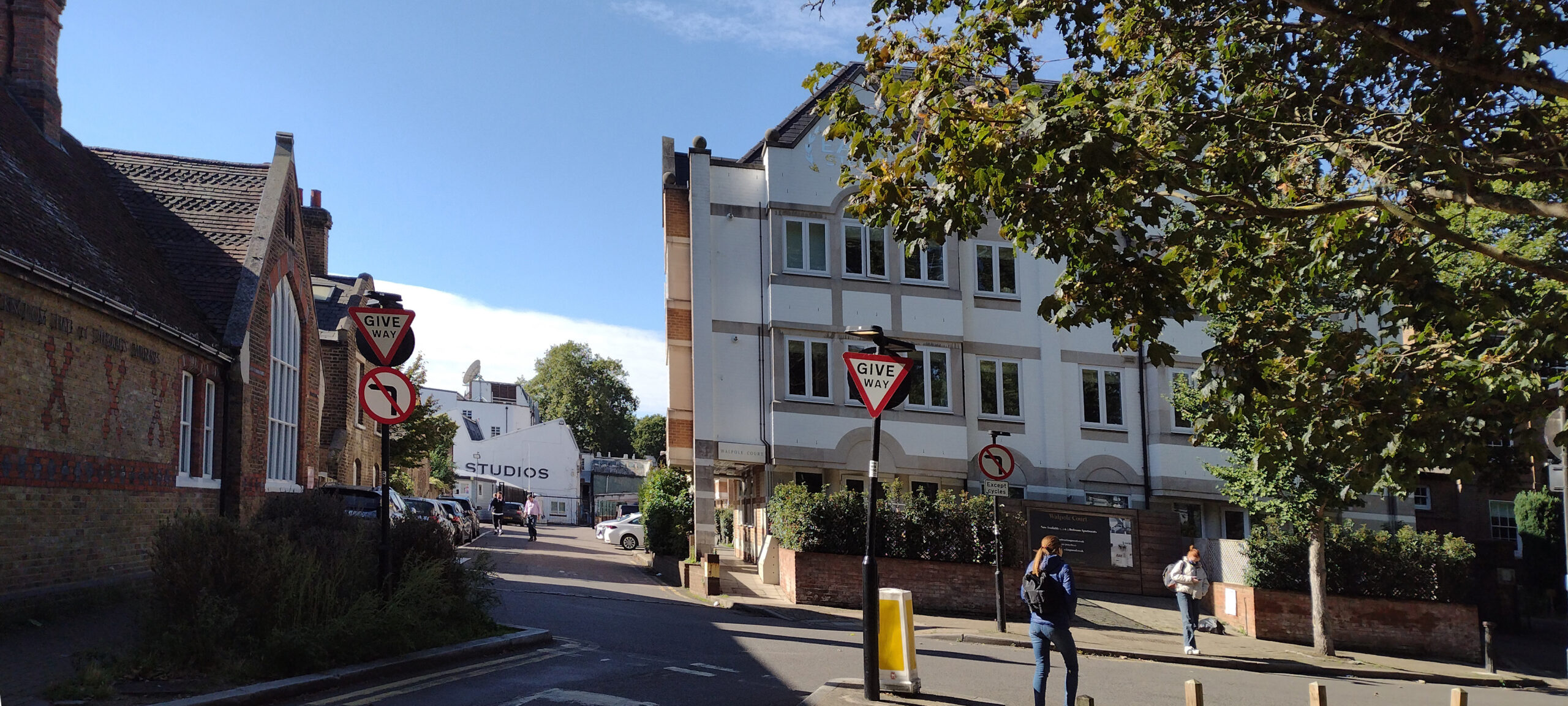
There was a rather splendid Victorian house which had the name Ealing Studios and displayed on the gables. I missed the turning on which it is situated, but in fact it fronted a  small park so I could see it from the main road, and then on my return I could turn and park nearby and take some photographs. It was quietly grand, but on close examination it appeared that it was in the process of being turned into flats.

However down the side you could see the warehouse that were the actual studios where between the years 1947 and 1955 that the famous comedies were made, starting with Kind Hearts and Coronets and ending up with the Lady killers.

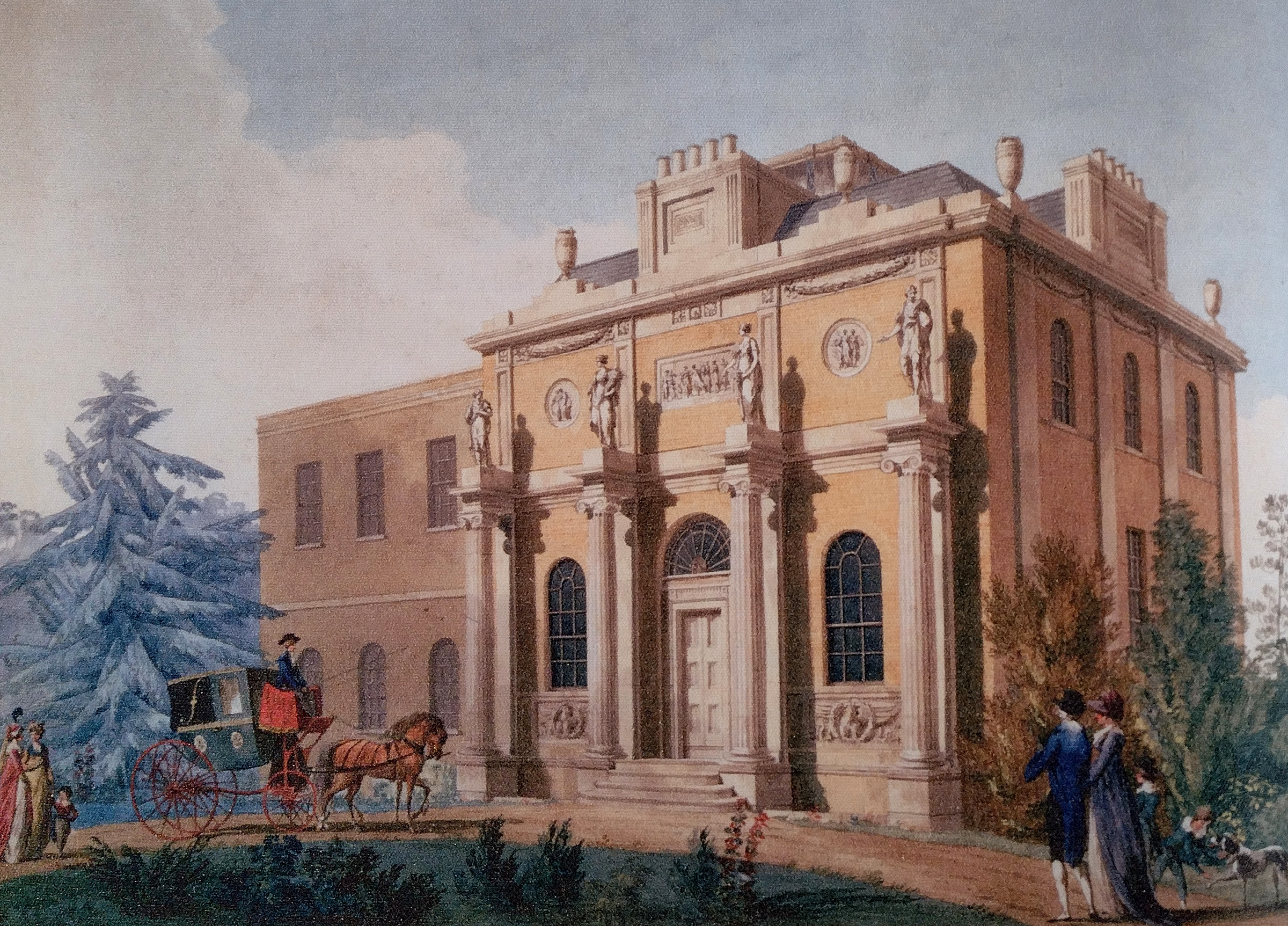
Pitzhanger Manor, as newly completed, painted by Joseph Gandy. The wing to the left is part of the original house, by George Dance. Guests are arriving by carriage from London, only an hour’s drive away, and are welcomed by Soane and his wife to the right.

However, while studying the maps I discovered that there was a grand country house adjacent called Pitzhanger Manor, so I decided to explore rather expecting that it would not be possible to park close by, but to my surprise, I discovered there was very good parking in the street just outside, so I parked the car using my blue badge and hobbled in.

The 1939 Library on the site of the original kitchens and the replica Roman ruins.

The first building had me puzzled, but it was an ancillary building.  The main house had been bought in 1900 by Ealing Borough Council and used as a library, but in 1939 they built a proper library building which is now used as an art gallery. There are extensive grounds originally covering some 30 acres which have recently been redone as per Soane’s original design With the help of a lottery fund grant, they were also able to do up the main house.

The grand facade of Pitzhanger Manor. Note the statues, (Caryatids) on the top of each column, very similar to those being installed by Soane at the Bank of England.

Beyond was the house itself. It was a grand house built by the architect Sir John Soane, the builder of the Bank of England (1753 to 1837). He purchased the original house in 1804 for  £4500, but then demolished most of the previous house and build his own. He intended it to be a showcase hoping to persuade his sons to become architects and to found an architectural dynasty. However, his sons disappointed him, so 10 years later he sold the house and made his townhouse in Lincoln’s Inn Fields in his principal monument, which is the day the Soane Museum.

 Inside on the ground floor was the ‘Eating Room’, a very large room where he entertained with grand views over the extensive gardens. Dinner usually took place at 430 to 5 and was considered an intellectual banquet.

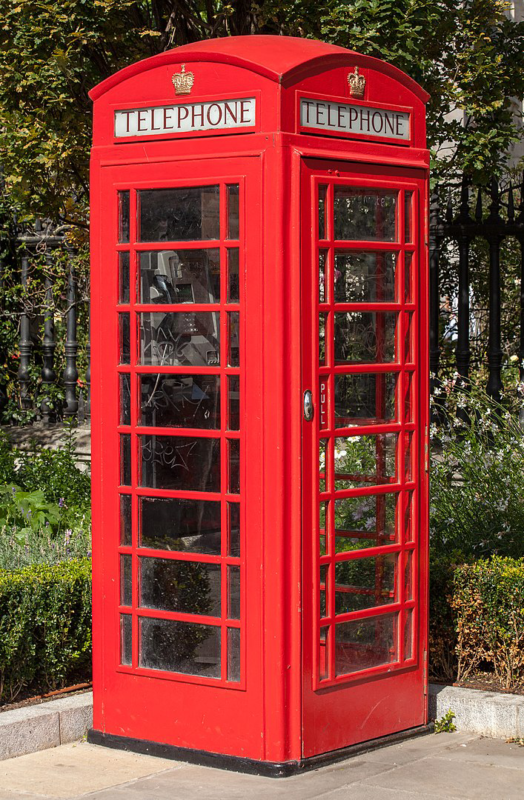
Here we see a view into the library, now sadly bereft of books, but note the double doors on three sides which enlarge the space. The walls are grained to look like yellow satinwood, and  note the elaborate ceiling where has a star fish design which makes it look airy and summery. Curved ceilings were as a speciality of Soane and are said to have influenced the design of the red telephone boxes.

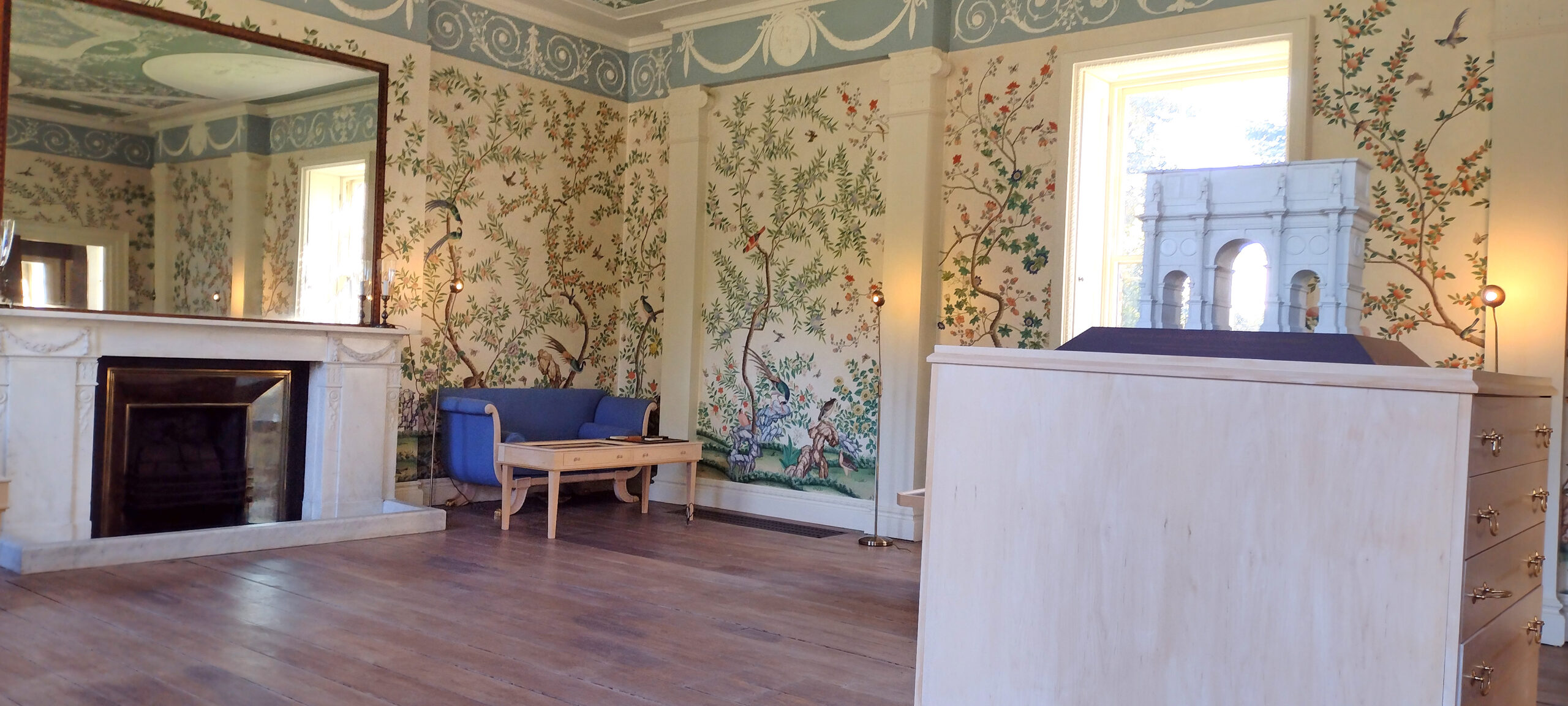
There were other rooms on several floors, of which I thought the finest was  the Upper Drawing room on a upper floor. This was in fact part of the original house designed by George Dance, under whom Soane learnt his trade, and he kept a wing of the original Dance house as a reminder of his early days, but he redecorated it with Chinese style wallpaper.

I much enjoyed my visit – though it was a pity that Wendy could not be with me.

Strawberry Hill

Strawberry Hill


Monday, 5 October 2020.


The civic centre at Twickenham

Today, 5th October 2020,I went for my interview for a blue badge for free parking and I had to go to Richmond town Hall, which is at Twickenham at the newly built Civic Centre. I was called at very short notice —the email came only came through on Friday. Unfortunately when I made my application, I was inveigled into a false website which charged me £60 instead of £10, but they did at least pass on the message even if rather late. I thought I would see a Doctor or at least a nurse, but in fact I saw a rather plump black lady who asked me a lot of questions in a difficult accident and wrote down the numerous answers over four pages. After about half an hour she accompanied me to the entrance and I suddenly realised it was all over. I hope she gives a good report.

But the sun was shining – if only for a few minutes,  so I thought I would do a little exploring and decided to give to Strawberry Hill which was on the other side of the town. I saw it from the road, and it was amazing. I was lured in by the very nice car park, and decided I would go round.

The library at Strawberry Hill with the books framed by a mediaeval archway which swung out if you needed books at the top

It was the extravaganza of Sir Robert Walpole, but its recent history has been unfortunate. The furniture was all sold off and in the 20th century, the whole estate was bought by St Mary’s Catholic University who built a university on the rest of the estate, but  didn’t know what to do with this crumbling ruin in a corner of their estate. Eventually it was taken over by a Trust, which raised £10 million and has done a splendid restoration.


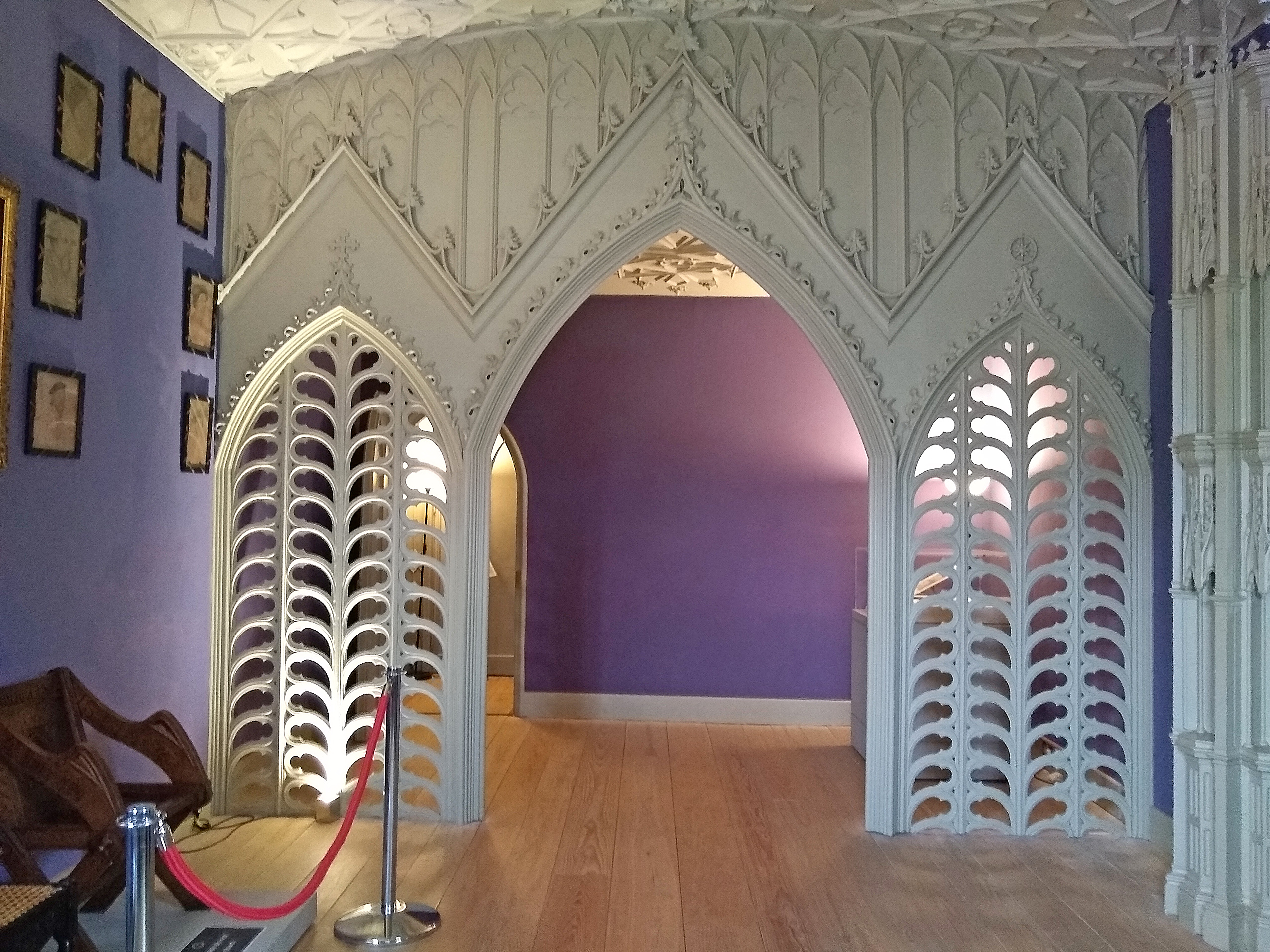
The Raphael room which originally had sketches by Raphael on the wall. But the end wall consisted of magnificent mediaeval archways.

They charge £12.50 with 10% discount from English Heritage and normally they only take parties, but I was given a private tour, and in each room, a lady took me over and gave me the tour.


The gallery, which formed the highlight of the visit to Strawberry Hill

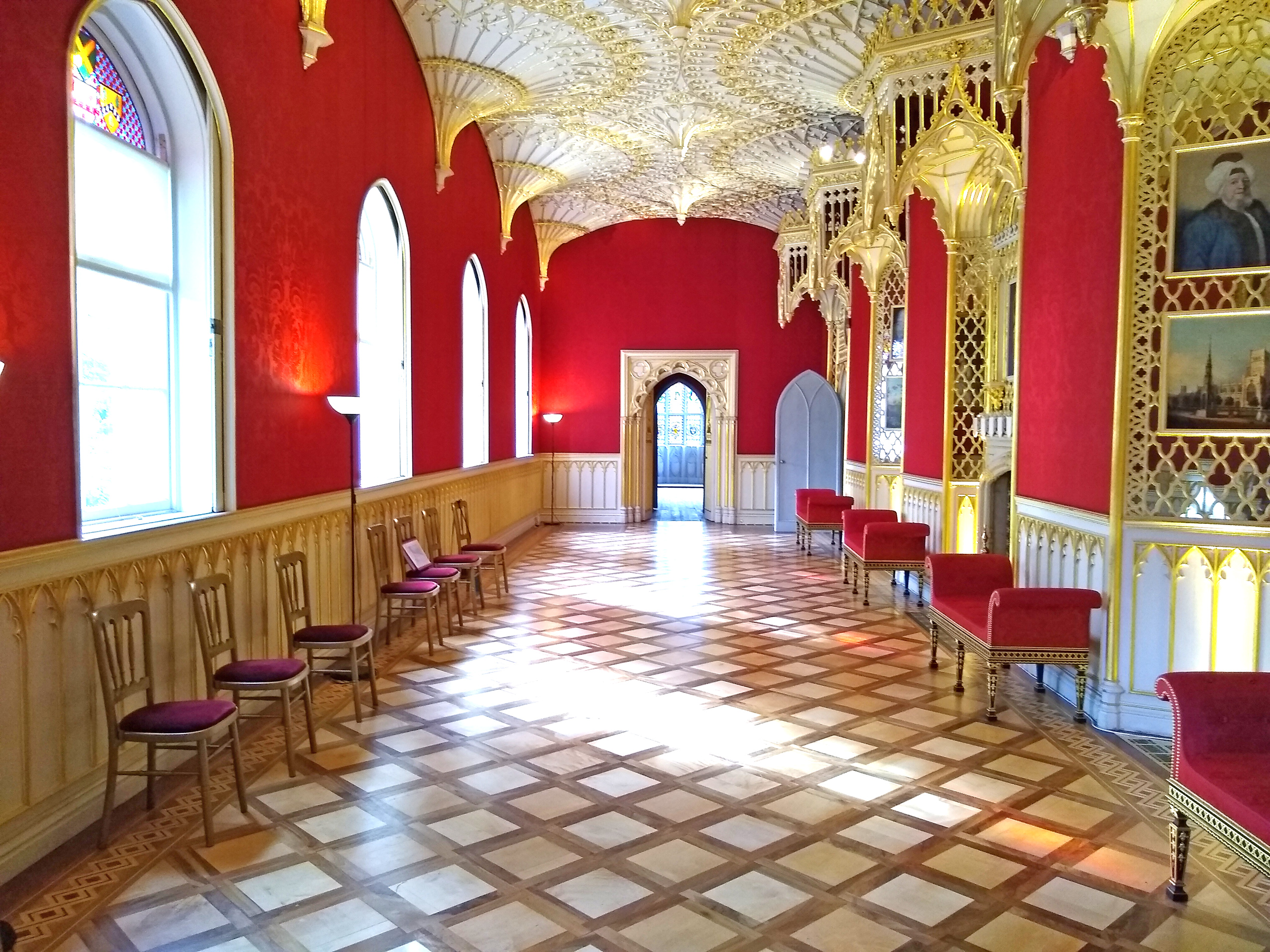
We went round the tour devised by Walpole, keeping the best bits to the end, so we saw various parlours and I enjoyed seeing the library,. But then at the end, I came out to the splendid Gallery, a Long Room all red and gold which is a magnificent showpiece.


The fine fireplace in the special Tribune at Strawberry Hill

And then at the end was his Round Drawing Room which was his special Treasury, and the Tribune leading off with a marvellous fireplace.

Wendy was very jealous that I had been without her, but I promised to take her as soon as possible.


I realised afterwards that there are three great houses to be seen at Twickenham. There is York House, which is where I was at the civic centre, which is an annexe to York House, which is now the actual Town Hall.  I must do it properly next time. Then there is Marble Hill house, which is the most classical, but is currently closed for restoration, though the park is still open. But I have now seen Strawberry Hill house, which is the finest of all!


Neighbours

Our next door neighbours, Kirsti and Antii have left. They were Finnish and he was working in Switzerland while she and the two children lived here next door to us. They have decided that they should all get together in Switzerland in Zurich where he has been living by himself during the lockdown period.

They have been good neighbours, though sadly we did not see as much of them as we should have done. Their elder daughter was at the same school and in the same class as Max.

Let’s hope we get nice neighbours. The house is rented, the owner living in France, in Auch. Let’s hope we get some nice replacements.

Friday 12th June  2020

May 2020

VE Day Anniversary, May 9th 2020

Yesterday, he was the 75th anniversary of VE Day, so we had a street party organised by Laura at number 2. It was a fine afternoon and went off very well.

Wendy talking to Laura and her husband. Don’t know who the girl in the miniskirt is.
Andrew and Wendy at the VE Day party. Photo taken by Laura or possibly her husband

Me, standing in the road, photo taken by Laura

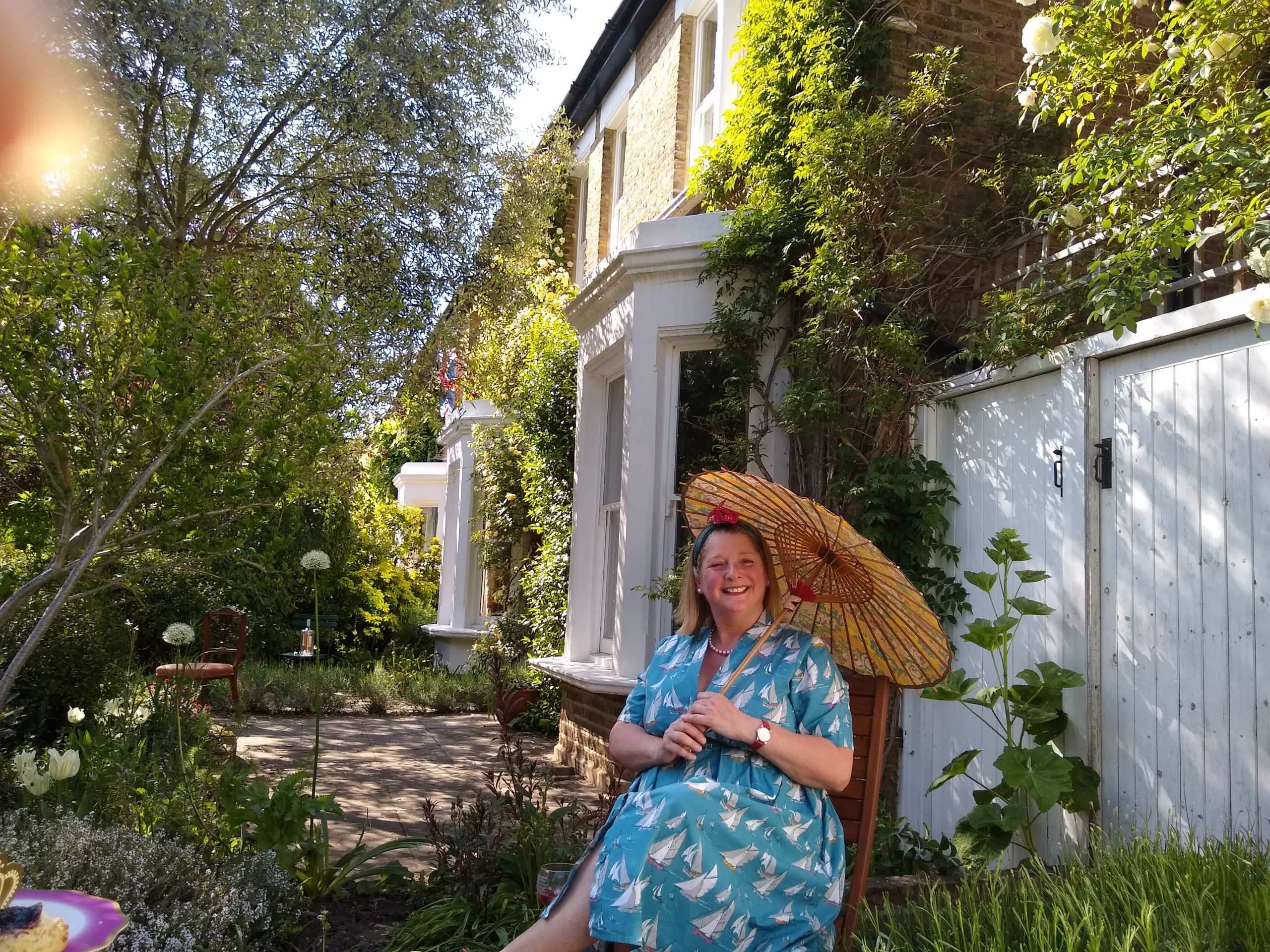
Laura sitting outside her house, with her grandmother’s parasol

In the evening. Wendy had ordered a meal from Rara which was very good.

My leg is still giving trouble from the ulcer. I have been along to see the nurse twice, once at the Kew retail Park surgery on Monday and then on Thursday at the Sheen Lane surgery. I am wearing stockings over the top of the bandage.

Jean, Wendy’s sister is apparently getting better. She has only rung up her daughter Jane once, but said that she is still alive and that the kidneys are still very poorly. Still we hope she is getting better slowly

I have not been doing much work on the book. At the beginning of the week I sent off an application to Coombs Moylett publishing agents, but have heard nothing in return not even a formal acknowledgement. I have finished my review of Greg Woolf’s book and sent it off to Matt. I have also been doing the final revision of my article on Roman Barcelona with a sad email from Carolina that Antonio’s wife has died from Corona virus and that he is in hospital.

I have started reading Peter Wiseman’s book on the House of Augustus.

I have been trying to make these Musings website work I do not know what success.

4.45

Have I just been out sunbathing naked in the garden – it’s a gorgeous day. However Wendy was sitting outside and when she saw me naked, she hastened to put something across my middle. But as soon as she went away, I took it off then 10 minutes later she came down and found something else to drape across my middle.

And why not sunbathe nude? to one side the Lithuanians have gone away, she has joined her husband in Switzerland for the shutdown and on the other side, they can only see me from an upper bedroom window, which I don’t think they used very much. So what the hell? In any case, Wendy is wearing her very short shorts in which she looks wonderful – she still has super legs!

May 12 2020

This afternoon, Wendy cut my hair!

Yesterday I dictated the house of Augustus to Ronwen, who sent it across and today I have been correcting it.

Yesterday in the evening I had a long session when I finally worked out how to transfer pictures from my mobile phone to the computer via a USB cable. It was a long process, but I eventually found the right click, hidden away, where you had to scroll down a lot of junk to see the crucial click.

But having done so I downloaded all my mobile photos of this year and some for last year and put them in the right folders . It is very good to have them all at full resolution

It has turned cold!

Today I have been preparing a long order from Sainsbury’s for delivery, 9 o’clock on Thursday evening. It already comes to £190

14th May

I had a good day yesterday. In the morning I put in some orders for Amazon for a jumpstart for the car and also some birthday presents for Izzi. But then in the evening I signed up to Jericho Writers to get some names of literary agents for my book. They give a weeks free access to their list of agents, after which it costs £30 a month. I signed up free for a week, but then I set to work, selecting those agents who mentioned ‘history’, and UK and found 251 potential agents. They come in seven batches and I downloaded the first batch on 10 sheets of paper and then went through them adding notes and found a couple of real possibilities.

I also thought of a new title for my book. Instead of Barbarism and Civilisation, how about How the Greeks invented Civilisation. I am inspired by this by seeing Matt Ridley’s blog about his new book he is about to get published called How Innovation Works. I thought I should try out the word ‘how’ in the title of my book. I think it works much better.

I have also been having some new ideas about how I present my philosophical ideas and I think the answer is to use the word ‘liberal’, or ‘liberalism’ or ‘classical liberalism’, but liberalism still sounds good and I can even add inspired by Hayek. I must now get down to rewrite all my introductions along these new lines.

April 29 2020

Family News

Bad news – Jean is very ill.

Jean, Wendy’s elder sister, fell out of bed several days ago and broke her leg. She was taken into Taunton hospital where they operated on her successfully, but she lost a lot of blood. But Jean will not take blood transfusions and consequently is in danger of dying. Her daughter, Jane, who lives just round the corner rushed her into hospital but her son Haydn lives in Taunton and is the only one who can see her. Wendy is very upset.

The weather has broken but we have had a wonderful run of good weather, with unbroken sun and I did a lot of sunbathing on the lawn. But yesterday it rained almost all day.

Sunbathing in the garden

My leg is still giving trouble. The wound that I received on Hadrian’s Wall has gone bad. It has been bandaged but I tried not to wear a stocking for a couple of days and it healed up slightly, but then I began having pain in the middle of the night. I went to sleep for a couple of hours but I did not move the leg and the blood did not get round and it began to hurt and was relieved only slightly if I got up and walked around.

For nearly a week I was in the habit of taking paracetamol, which relieved the pain and allowed me to get back to sleep and when I woke up in the morning it had all gone. Yesterday I wore stocking for most of the day, and then I put the stockings on again at night and I slept through without pain, but the pad that I left under the stocking was very bloody. I think I ought to contract the doctors.

Downsizing revised

We’re downsizing!


After forty seven years living in our wonderful family home at 9 Nassington Road in Hampstead, we have moved to a cottage in Kew, in West London. We want to be nearer the grandchildren.

Let’s start by looking at our old home, at 9 Nassington road

This is number 9 Nassington Road, where we live very happily for 47 years. We did not actually launch Current Archaeology from here —we spend our first three years in Islington at 128 Barnsbury Road, a small undeveloped Georgian terraced house.  It had possibilities as they say, but it would not really have been big enough for a growing family, so my parents ‘downsized’ and enabled us to move to a somewhat larger house a couple of miles to the west in Hampstead.

It was an inspired choice, for Nassington Road has been a wonderful home, both for bringing up the children and for producing Current Archaeology, and it enabled me to participate in one of the great joys of life – bringing up our children.

It was in a wonderful situation on the southern slopes of Hampstead Heath – the Heath was just 200 yards away. The house faced north – this photo was taken in the very early  morning —and from the front it had three storeys.

However from the back it was a different story.

The house was on sloping ground so one entered to the ground floor and then went down to the basement floor, which entered straight onto the garden.

There is the view of the house from the garden. The black plates were inserted following the very dry summer of 1976 when we were very worried that the back wall shows signs of movement. We need not have worried – the back wall has been rock solid ever since.

GMT

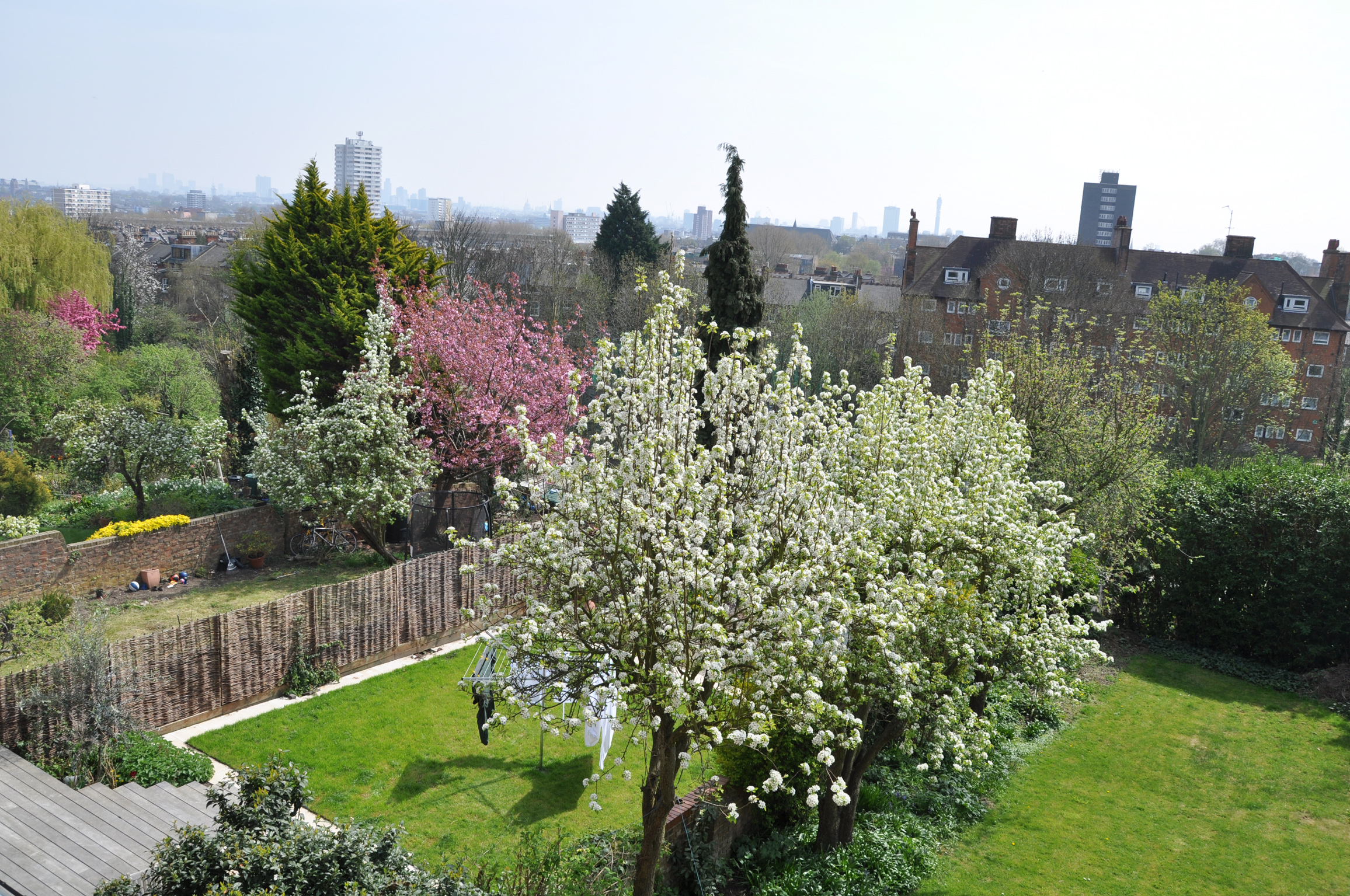
However, if you look out from the windows, you can see our wonderful view. The greatest advantage of Nassington road is that looking south, you can see the whole glory of London. To see the some of the features in detail, click here

Scroll to Top