Fulham Palace
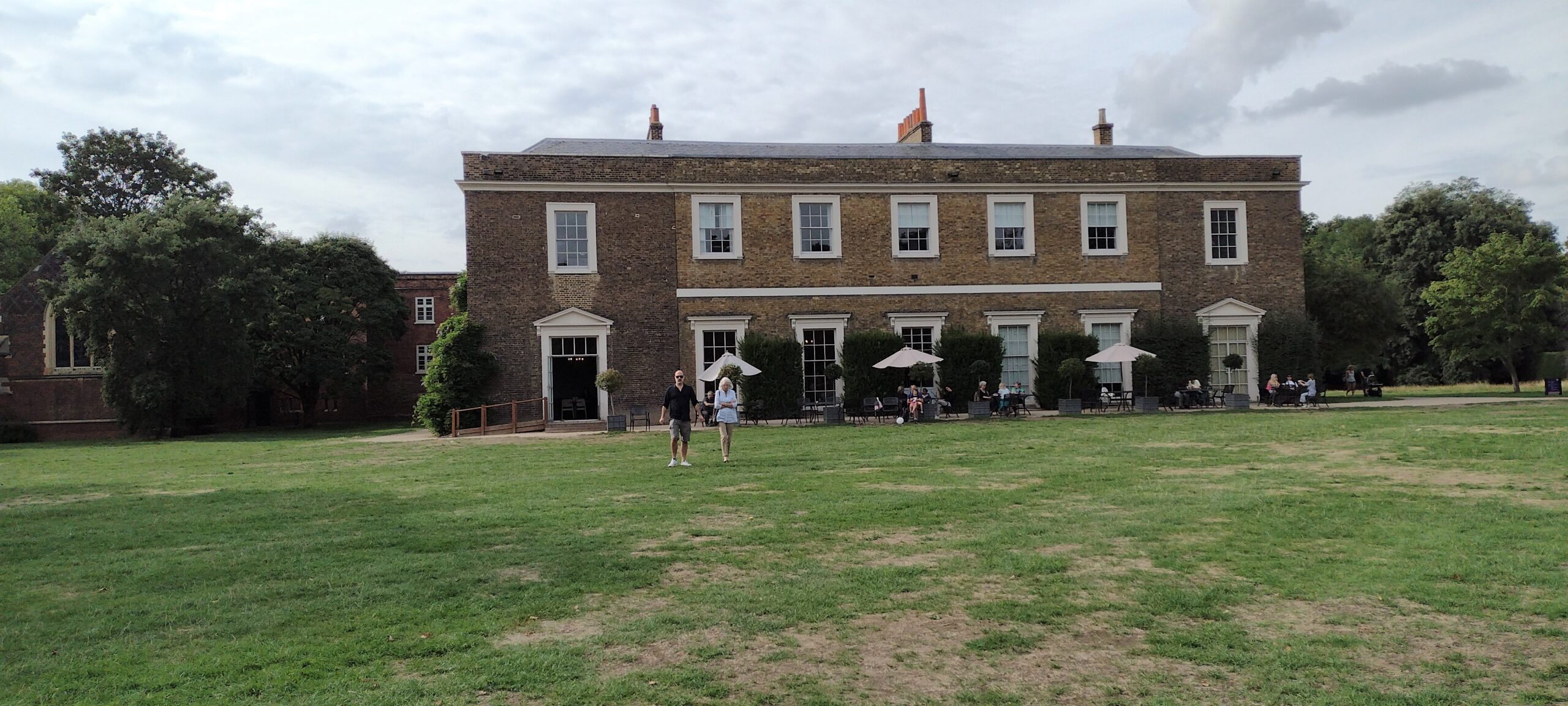
I have been wanting to go to Fulham Palace ever since I heard a lecture on it at the Richmond Archaeological Society. Well, another lecture is coming up, so I thought I had better delay no longer, so I could appreciate what the forthcoming lecture is all about..
I had been saying that I wouldn’t go on a weekday to avoid the crowds, and that I would go on a nice sunny day. Well, I missed all the nice sunny days in the summer of 2022, and eventually with the next lecture coming up, I decided to go on a Saturday, 3rd September 2022. It was a dull day and we coincided with a wedding, so we couldn’t see the main Tudor Court. But we saw the Museum and the Great Hall, so we still has a good visit and Wendy enjoyed it.
Fulham Palace was the home of the Bishops of London on a riverside estate acquired by Waldhere, the Bishop of London in 704. However it was rather large, and not very central to London, so in 1972 it was given up, in favour of a small house in central London just by St Paul’s, which is, after all, the Church of the Bishop of London, and it is now run by a trust.
It is in two parts. The original half is the Tudor Court, which was where the wedding was being held, so we couldn’t get in to see it. Then in the 18th and 19th centuries it was considered to be too old-fashioned, so new buildings were added around what became the East Court. We saw the museum rooms and the Great Hall, where Wendy identified the portraits of the various kings and queens, and we then went through the northern wing of the East Court till we came to the Drawing room, which is now the cafe. There we each had a large coffee and shared a piece of chocolate cake between us – Wendy allowed me half, despite my diabetes.

We then walked across the lawn to the walled garden. In the 17th century, the Bishop of London was also the head of the church in the American colonies, and Bishop Henry Compton (1675 – 1713) was a keen botanist, so he sent out Rev Banister, himself a keen botanist as a missionary and plant collector to Virginia, who sent back many plants including magnolia and box elder. In 1764 a walled garden was constructed, with an earlier Tudor gateway which I failed to photograph.
We got there just before it was closing. We saw part of it until we were chased out, and Wendy went on ahead to go to the shop to buy greetings cards and I returned to the car in the disabled car park. And so to home.